Color Science
How Owens Corning Develops New Shingle Colors
Inside the lab shaping roofing color
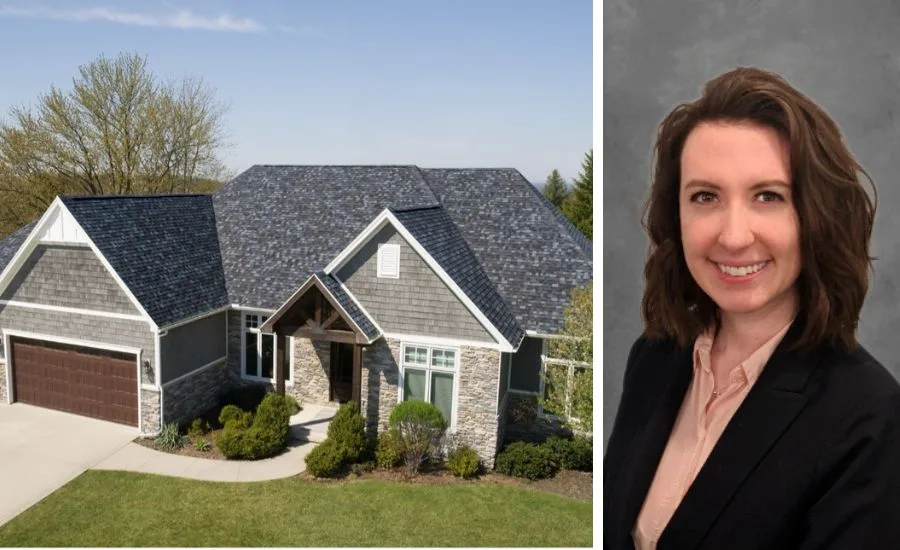
(Left) Shingle boards and online tools simplify color selection, but viewing a shingle in natural light is always recommended. (Right) Paige Paulson, aesthetics engineer, Owens Corning.
You may not be familiar with the title “aesthetics engineer.” While it may sound like a fancy name for someone who makes stuff look nice, there’s far more to the title. Recently, Paige Paulson, aesthetics engineer at Owens Corning, shared some insight into her role and what’s involved in shaping the style of shingles.
Tell us about your role as an aesthetics engineer.
I work with our quality teams on cool technologies, algae resistance, our premium lines and obviously color. I also really love working on new products, which is likely what comes to mind when people think about science and technology (S&T) and innovation. But working in aesthetics means I’m also very plugged into our manufacturing plants. I help ensure that any change made in equipment or on the production lines doesn’t affect color quality and consistency.
How does Owens Corning develop new colors?
We typically start the new color development process with a prompt. Prompts usually come from feedback on colors or observations of a color gap in our product lines.
For example, we just released new designer colors including a couple of greens—Evergreen Mist and Mountain Pine. For those, we asked ourselves, “How do we make a designer green shingle?” We created 14 color palettes from that prompt. Then we started narrowing it down, sharing ideas, getting feedback from others, homing in on the colors that we felt were the top contenders. We then started moving through the process, doing small-scale prototyping at our color lab in Granville, Ohio.
At each stage of the process, we keep narrowing it down until we reach the one with the most potential.
Tell us about the Owens Corning color lab and its resources.
The color lab is designed to be a place where we can create a completely new color, or we can make tweaks in an existing color. The lab is supplied with every granule that we use at all of our roofing plants. Lighting and the color of a room can impact color, so everything inside the lab is finished in a neutral gray—the walls, the equipment—to make sure the background doesn’t affect how we see the colors. It also has different lighting options—fluorescent, incandescent, LED—we can even simulate lighting outside. I always encourage contractors to have their customers view their shingle choice outside under natural light. That’s the environment where you’ll view the color.
Have you ever had any big surprises with a color you were creating?
You might not expect it, but one of the toughest colors for us to design was Midnight Plum. It was a tricky one to get right, because there are no purple granules. To achieve that shade of color, we had to get the perfect ratio of red and blue granules mixed together. At each of the plants we qualified it at, we had to take our time, take it outside in the daylight to make sure we got it right. It was very challenging because we get granules from different quarries and those nuances affect color.
How do you ensure color consistency among your different manufacturing facilities?
Our Regional Shingle Program matches shingle colors across plants, because most colors are regional. Four quarries supply granules across the U.S. If you mix granules from more than one quarry, the shingles won’t match. They’ll look patchy. To mitigate that, we qualify the color at the first plant, assuring it looks perfect. We then take those control shingles to each subsequent plant and verify that they match. Since each plant is different, it’s very important to confirm that those control shingles correspond.
How does product design safeguard against the effects of algae growth?
We do a lot of research on climate areas. Wet regions and damp, cool situations encourage algae growth. For instance, there’s often more algae growth on the northern side of a roof, because it gets less direct sunlight. Algae growth causes black streaking, which is not aesthetically pleasing. Our shingles include copper granules that slowly leach out, with moisture acting as an algaecide.
Why should contractors feel comfortable advising customers on shingle colors?
Roofing contractors don’t have to be the end-all expert. Owens Corning leads in color and can supply so many resources. Our website provides design tools and color selection tips. Contractors can lean on those tools, providing them to homeowners to help steer the conversation and enable their customers to find the perfect color for their home.
Looking for a reprint of this article?
From high-res PDFs to custom plaques, order your copy today!