Quarterly Report
Asphalt Shingle Demand Falls 9.9% in Q1 as Costs Surge
Shipments decline for a second straight first quarter while rising fuel and materials prices add pressure across roofing markets

Asphalt shingle demand opened 2026 with another decline, as shipments fell sharply year over year and rising materials costs added fresh pressure to an already cooling roofing market.
Data from the Asphalt Roofing Manufacturers Association shows U.S. asphalt shingle shipments fell 9.9% in the first quarter to 38.1 million squares, down from 42.3 million in Q1 2025. The decline follows a 1.7% drop in Q1 2025 and marks one of the weaker first-quarter volumes of the past several years, though not a record low.
Other roofing categories fell more sharply. Built-up roofing (BUR) shipments dropped 16.7% year over year to 834,560 squares, while modified bitumen declined 13.8% to 9.1 million squares. Canadian shingle shipments fell 13.4% to 3.2 million squares, giving back some of the strong gains recorded in 2025.
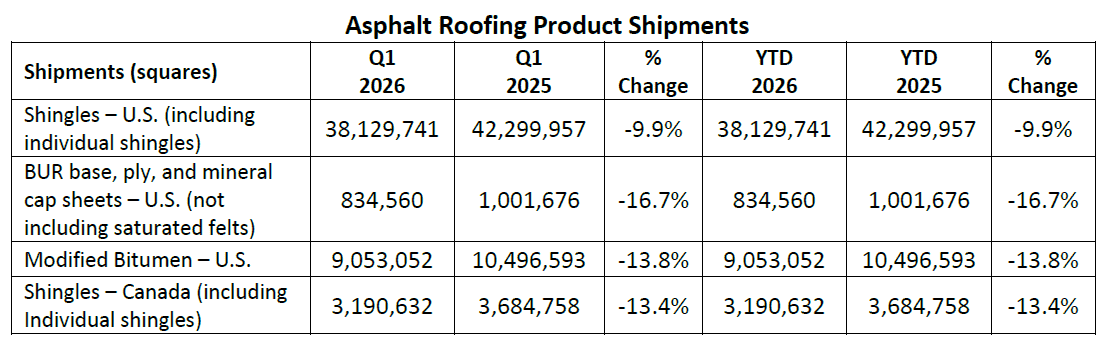 Source: Asphalt Roofing Manufacturers Association
"Asphalt roofing data is relevant and meaningful to a number of industries," said ARMA Executive Vice President Reed Hitchcock. "The shipment report provides valuable insight into the asphalt roofing industry to ARMA members, trade professionals and other interested parties."
The across-the-board declines stand in contrast to the sequential picture, which reflects normal seasonality. All four categories rebounded from Q4 2025 lows: U.S. shingles rose about 41% quarter over quarter, Canadian shingles surged roughly 137%, modified bitumen increased about 29%, and BUR edged up around 7%. Those gains are consistent with typical winter-to-spring patterns but do not offset the broader year-over-year declines.
Construction Pipeline
The demand slowdown reflected in ARMA’s shipment data aligns with a construction pipeline that remains uneven. Residential starts, the most direct driver of shingle demand, are still running below year-ago levels despite a modest monthly gain, limiting near-term support for volumes. In nonresidential, total construction starts jumped in March on strength in large infrastructure and utility projects, but that growth has yet to translate into broad-based building activity. Further out, the Dodge Momentum Index points to a narrow pipeline: while planning activity remains elevated overall, recent gains have been driven almost entirely by data center projects, with commercial and institutional segments losing ground. Taken together, the data suggests that while activity persists, both the current and future demand environment for roofing remains constrained outside of a few concentrated areas.
"Planning momentum in March was powered almost entirely by data center projects, with most other sectors easing back," said Sarah Martin, associate director of forecasting at Dodge Construction Network. "For some categories, this reflects a natural reset after the outsized growth in late 2025. But for others, elevated macroeconomic risks are likely beginning to feed into planning decisions."
Commercial planning excluding data centers declined 12.7% year over year in March, and institutional planning fell 8.8% for the month — a narrowing of the pipeline’s breadth that points to limited near-term recovery in commercial roofing segments.
Rising Material Costs
Materials costs are accelerating at the fastest pace in more than two years, creating a compounding headwind. Construction input prices rose 2.2% in March compared to the prior month, with nonresidential inputs up 2.3%, according to an analysis by Associated Builders and Contractors of Bureau of Labor Statistics producer price index data. Year over year, overall construction input prices are up 4.8% — the largest annual gain since January 2023 — while nonresidential inputs are up 5.4%. At an annualized rate, input prices increased 18% in the first quarter of 2026.
"Construction materials prices surged in March and are now up 4.8% year over year, the largest annual increase since January 2023," said Anirban Basu, ABC chief economist. "This monthly increase is due to higher oil prices, a direct result of conflict in Iran, and it remains to be seen how that geopolitical event will affect other input prices in the months to come."
The primary driver was a sharp jump in energy costs. Crude petroleum prices increased 20.2% in March, while diesel fuel surged 37.8% from February to March — the largest one-month rise since 1990, according to the Associated General Contractors of America — and continued climbing after mid-March. Key metals compounded the pressure: aluminum mill shapes rose 34.1% year over year, copper and brass mill shapes gained 21.3%, and steel mill products climbed 15.4%.
"The staggering jump in fuel costs only reflects prices as of mid-March," said Ken Simonson, AGC chief economist. "Diesel fuel prices have continued to rise sharply since then, while supply disruptions tied to the Middle East conflict are pushing costs higher."
"Because contractors can seldom pass along cost increases after committing to a project, these extreme, sudden jumps are causing major hardship," added AGC CEO Jeffrey Shoaf. "In addition, uncertainty over future costs and demand for structures may cause owners to delay or cancel projects, slowing construction activity."
"The bigger shift has been adapting to sustained cost pressure rather than short-term spikes," David Nye, Chief Growth Officer at Peak Roofing Partners and former owner of SkyMark Roofing, told Roofing Contractor. "That requires tighter operational controls, disciplined purchasing, and a constant focus on maintaining efficiency while delivering consistent quality."
Looking for a reprint of this article?
From high-res PDFs to custom plaques, order your copy today!