Energy-Saving Landmark: Vancouver Convention Centre Sports Distinctive Green Roof
Garden roofs are a scenic application swiftly gaining popularity for commercial buildings in metropolitan areas globally. Part of the reason for their popularity is because their sustainability benefits are numerous.
Garden roofs are a scenic application swiftly gaining popularity for commercial buildings in metropolitan areas globally. Part of the reason for their popularity is because their sustainability benefits are numerous. Garden roofs are indeed green as they lower energy costs, reduce waste, help minimize the urban heat island effect, and help manage storm water runoff. Not only do they provide durability and scenery for the buildings on which they are installed, but to neighboring structures as well.
When designers of the new expansion of the Vancouver Convention Centre - the site of the International Broadcast Center for the 2010 Olympic and Paralympic Winter Games - specified a green roofing system for the 1.15 million square foot complex, they were looking for a new twist on a familiar concept.
For one thing, designers wanted a roofing system that could hold water because of grass that would be grown there - over 20 species of grass and plants, to be specific. And then there’s the electronic field vector mapping system for leak detection, and the built-in irrigation system, both of which required special consideration when choosing a roofing material.
The team of building professionals settled on extruded polystyrene (XPS) foam insulation, a material that has earned its high quality reputation among decision makers on the project.
“We use XPS foam a lot. It’s one of our staple of roofing elements, particularly in areas where there is a lot of rain,” said architect Jacques Beaudreault, partner, Musson Cattell Mackay Partnership, one of three architects on the project. “Our firm looks at the best products for the roof membrane as well as the insulation system because it’s a major component of what could go wrong on a structure.”

The expanded Convention Centre contains a massive exhibition hall, 72 meeting rooms, two ballrooms and two kitchens. With 169 bookings already after its official opening in April 2009, the building’s most visible tenant will be reporters from all over the world who will converge upon Vancouver for the 2010 Winter Olympics and Paralympic Winter Games. The structure is protected by the largest green roof in Canada - a 6-acre roof that has no flat surface and no two surfaces the same size or shape.
It was designed with the goal of Leadership in Energy and Environmental (LEED) Gold certification. LEED is a voluntary, consensus-based standard that recognizes and seeks to minimize the life-cycle cost of construction. Although not a code or zoning requirement, many owners and government agencies now require their facilities to be LEED certified. And, more and more cities and localities are adopting legislation requiring green roofs. For example, the city of Toronto has passed legislation requiring garden roofs to be used to manage urban heat island effects. The regulations will require green roofs on new residential buildings in the city starting Jan. 31, 2010, that are more then 2,000 square meters and 20 meters or higher. Industrial construction will have an extra 12 months to prepare for the requirements. For industrial buildings they will have to reserve either 10 percent of the roof area or 2,000 square meters, and have the option to choose the lesser amount for sod and other greenery.
The LEED rating system assigns credits to a design based on meeting criteria for sustainable design concepts, and the use of environmentally responsible, sustainable and energy-efficient products and systems. By reaching certain point levels, buildings can be LEED Certified, Silver, Gold or Platinum. In some states/provinces and localities, LEED certification can result in financial incentives. When XPS foam insulation is used in green roof assemblies, its use may enable design concepts, like green roofing, that contribute to LEED points for new construction and major renovations in categories including sustainability, water efficiency and energy performance. It should be noted that an individual material alone does not enable a LEED credit point. LEED credits for design are based on system performance, while LEED credits for recycled content or regional sourcing are dependent on all materials and their proportionate relationship to the total dollar cost of all materials.
“If you look at a drawing of downtown Vancouver, you see Stanley Park as a major green space element in that area,” Beaudreault said. “We thought this was a great opportunity to complete the ribbon of park with a major green roof that connects Stanley Park to the downtown.”
“As the design evolved, we wanted to create a living roof - a sanctuary for things like fauna and critters that live in the grasses and soil,” he continued. “We wanted it to become a sanctuary for native plants and birds and bees and butterflies that are not often seen in the downtown area. This led us to shape the roof with angles, so it tips toward the ground for visibility, and that’s how the green roof came to life.”
Ken Grassi, design and development manager for the Vancouver Convention Centre Expansion Project, was involved with the project from the start. “There were some of us who thought, ‘Are you guys crazy?’ when they first suggested the roof,” he said. “There was some skepticism at the beginning, but I think it came from not knowing the technical aspects. As time went by, we began to learn more and our concerns dissipated.”
“This roof has some elements that are not common in a typical green roof design and that certainly resulted in a lot of discussion about the appropriate system to use,” he said. “When you’re looking for an insulation product suitable for below-grade applications where moisture is ever-present, you have very few options. Extruded polystyrene insulation is one of the only products available, and is well respected in green roofing systems.”
Historically, extruded polystyrene foam insulation manufacturers pioneered a new kind of assembly in 1968 that turned roofing theory “upside-down” - literally creating long-lasting garden roofs that protect against the outdoor elements and support the weight of soil, vegetation and foot traffic at the same time. Because the XPS insulation is installed on top of the waterproofing membrane, rather than below it, the then-innovative practice is now known as a protected membrane roof (PMR) assembly.
The National Roofing Contractors Association notes that XPS is the only recommended insulation for garden roofs due to its inherent ability to resist water absorption and its high compressive strength. (See The NRCA Vegetative Roof Systems Manual, 2009 Second Edition; Section 2.5; Moisture-Resistant Insulation, page 46.)
Planners for the convention center also needed a system that could hold water to irrigate the many species of grasses and a root barrier that could protect the membrane from root damage. Lastly, they wanted a way to control unwanted plants and weeds that have a tendency to invade green roof systems.
“In this system, we are encouraging vegetative growth, which required a change in mentality for us as we designed the roofing system,” Lawton said. “Extruded polystyrene foam is used by many suppliers of green roof systems, and we’re happy to see it specified in our jobs.” According to Beaudreault, reliability was another major factor. “We wanted to make sure all of the components of this green roof were the best that we could find because it minimizes problems,” he said.
PRM assemblies typically last 40 years or more, which is more than twice as long as a conventional roofing system. Due to the innovative design of garden roofs installed with XPS, leaks are often easier and less costly to isolate than in other roof assemblies. With less frequent roof replacements and fewer repairs, a PRM assembly maximizes the long-term return on investment with reduced waste and replacement costs.
Garden roofs are a scenic application swiftly gaining popularity for commercial buildings in metropolitan areas globally. Part of the reason for their popularity is because their sustainability benefits are numerous. Garden roofs are indeed green as they lower energy costs, reduce waste, help minimize the urban heat island effect, and help manage storm water runoff. Not only do they provide durability and scenery for the buildings on which they are installed, but to neighboring structures as well.
When designers of the new expansion of the Vancouver Convention Centre - the site of the International Broadcast Center for the 2010 Olympic and Paralympic Winter Games - specified a green roofing system for the 1.15 million square foot complex, they were looking for a new twist on a familiar concept.
For one thing, designers wanted a roofing system that could hold water because of grass that would be grown there - over 20 species of grass and plants, to be specific. And then there’s the electronic field vector mapping system for leak detection, and the built-in irrigation system, both of which required special consideration when choosing a roofing material.
The team of building professionals settled on extruded polystyrene (XPS) foam insulation, a material that has earned its high quality reputation among decision makers on the project.
“We use XPS foam a lot. It’s one of our staple of roofing elements, particularly in areas where there is a lot of rain,” said architect Jacques Beaudreault, partner, Musson Cattell Mackay Partnership, one of three architects on the project. “Our firm looks at the best products for the roof membrane as well as the insulation system because it’s a major component of what could go wrong on a structure.”
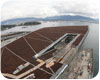
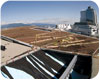
In the building’s protected membrane roof (PMR)
assembly, the XPS insulation is installed on top of the waterproofing membrane
and the growth media and plants are installed above the insulation. (Photos
courtesy of the XPSA.)
A LEED-Certified Landmark
The Vancouver Convention Centre is one of the most high-profile buildings in the city. It sits on an 11-acre harbor-front site and completes an expansive stretch of parkland which winds along the shoreline adjoined to Stanley Park.The expanded Convention Centre contains a massive exhibition hall, 72 meeting rooms, two ballrooms and two kitchens. With 169 bookings already after its official opening in April 2009, the building’s most visible tenant will be reporters from all over the world who will converge upon Vancouver for the 2010 Winter Olympics and Paralympic Winter Games. The structure is protected by the largest green roof in Canada - a 6-acre roof that has no flat surface and no two surfaces the same size or shape.
It was designed with the goal of Leadership in Energy and Environmental (LEED) Gold certification. LEED is a voluntary, consensus-based standard that recognizes and seeks to minimize the life-cycle cost of construction. Although not a code or zoning requirement, many owners and government agencies now require their facilities to be LEED certified. And, more and more cities and localities are adopting legislation requiring green roofs. For example, the city of Toronto has passed legislation requiring garden roofs to be used to manage urban heat island effects. The regulations will require green roofs on new residential buildings in the city starting Jan. 31, 2010, that are more then 2,000 square meters and 20 meters or higher. Industrial construction will have an extra 12 months to prepare for the requirements. For industrial buildings they will have to reserve either 10 percent of the roof area or 2,000 square meters, and have the option to choose the lesser amount for sod and other greenery.
The LEED rating system assigns credits to a design based on meeting criteria for sustainable design concepts, and the use of environmentally responsible, sustainable and energy-efficient products and systems. By reaching certain point levels, buildings can be LEED Certified, Silver, Gold or Platinum. In some states/provinces and localities, LEED certification can result in financial incentives. When XPS foam insulation is used in green roof assemblies, its use may enable design concepts, like green roofing, that contribute to LEED points for new construction and major renovations in categories including sustainability, water efficiency and energy performance. It should be noted that an individual material alone does not enable a LEED credit point. LEED credits for design are based on system performance, while LEED credits for recycled content or regional sourcing are dependent on all materials and their proportionate relationship to the total dollar cost of all materials.
Why a Green Roof?
In keeping with the bid and Vancouver 2010 sustainability commitments, the Vancouver Convention Centre Expansion Project team wanted a sustainable building. Applying a green roof assembly was a natural solution. But there was another reason. Because the complex is surrounded by high-rise buildings that look down on it, designers wanted to leave a visual impression from that bird’s-eye view - one that made the structure appear as if it were an extension of downtown’s Stanley Park green space.“If you look at a drawing of downtown Vancouver, you see Stanley Park as a major green space element in that area,” Beaudreault said. “We thought this was a great opportunity to complete the ribbon of park with a major green roof that connects Stanley Park to the downtown.”
“As the design evolved, we wanted to create a living roof - a sanctuary for things like fauna and critters that live in the grasses and soil,” he continued. “We wanted it to become a sanctuary for native plants and birds and bees and butterflies that are not often seen in the downtown area. This led us to shape the roof with angles, so it tips toward the ground for visibility, and that’s how the green roof came to life.”
Ken Grassi, design and development manager for the Vancouver Convention Centre Expansion Project, was involved with the project from the start. “There were some of us who thought, ‘Are you guys crazy?’ when they first suggested the roof,” he said. “There was some skepticism at the beginning, but I think it came from not knowing the technical aspects. As time went by, we began to learn more and our concerns dissipated.”
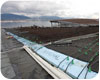
The Vancouver Convention Centre will be the site
of the International
Broadcast Center
for the 2010 Olympic and Paralympic Winter Games. The complex features a green
roofing system with an electronic field vector mapping system for leak
detection and a built-in irrigation system. (Photos courtesy of the XPSA.)
The Best Materials
Building Envelope Consultant Mark Lawton, of Morrison Herschfield, agreed with the decision to use extruded polystyrene insulation because it has material properties that resist water absorption when installed in what’s known as an intensive configuration or protected membrane roof (now commonly called a green roof) such as the Vancouver Convention Centre.“This roof has some elements that are not common in a typical green roof design and that certainly resulted in a lot of discussion about the appropriate system to use,” he said. “When you’re looking for an insulation product suitable for below-grade applications where moisture is ever-present, you have very few options. Extruded polystyrene insulation is one of the only products available, and is well respected in green roofing systems.”
Historically, extruded polystyrene foam insulation manufacturers pioneered a new kind of assembly in 1968 that turned roofing theory “upside-down” - literally creating long-lasting garden roofs that protect against the outdoor elements and support the weight of soil, vegetation and foot traffic at the same time. Because the XPS insulation is installed on top of the waterproofing membrane, rather than below it, the then-innovative practice is now known as a protected membrane roof (PMR) assembly.
The National Roofing Contractors Association notes that XPS is the only recommended insulation for garden roofs due to its inherent ability to resist water absorption and its high compressive strength. (See The NRCA Vegetative Roof Systems Manual, 2009 Second Edition; Section 2.5; Moisture-Resistant Insulation, page 46.)
Planners for the convention center also needed a system that could hold water to irrigate the many species of grasses and a root barrier that could protect the membrane from root damage. Lastly, they wanted a way to control unwanted plants and weeds that have a tendency to invade green roof systems.
“In this system, we are encouraging vegetative growth, which required a change in mentality for us as we designed the roofing system,” Lawton said. “Extruded polystyrene foam is used by many suppliers of green roof systems, and we’re happy to see it specified in our jobs.” According to Beaudreault, reliability was another major factor. “We wanted to make sure all of the components of this green roof were the best that we could find because it minimizes problems,” he said.
Sustainability and Energy Savings
With XPS insulation, PRM assemblies provide a thermal barrier with an effective aged R-value of 5.0 per inch that helps prevent outside temperatures from straining the heating, ventilating and air conditioning (HVAC) systems. Reducing the load on the mechanical equipment, can dramatically reduce the building’s energy bills, as well as minimize the size - and cost - of the required HVAC units. Building owners typically recoup the investment cost in energy savings and maintenance costs within seven years of installation.PRM assemblies typically last 40 years or more, which is more than twice as long as a conventional roofing system. Due to the innovative design of garden roofs installed with XPS, leaks are often easier and less costly to isolate than in other roof assemblies. With less frequent roof replacements and fewer repairs, a PRM assembly maximizes the long-term return on investment with reduced waste and replacement costs.
Looking for a reprint of this article?
From high-res PDFs to custom plaques, order your copy today!