ERA Recycling
When it comes to specifying roofing products, energy savings and sustainability are important considerations, but the ability to recycle these products is just as important. With that in mind, the EPDM Roofing Association (ERA) has been conducting a research project into the possible recycling of its product over the past 18 months. The initial re-sults from the pilot phase have been very encouraging.

 When it comes to specifying roofing products, energy savings and sustainability are important considerations, but the ability to recycle these products is just as important. With that in mind, the EPDM Roofing Association (ERA) has been conducting a research project into the possible recycling of its product over the past 18 months. The initial re-sults from the pilot phase have been very encouraging.
The goal of the project, as established by the EPDM industry task force, was threefold:
br> The first pilot project was Cookson Elementary School in Troy, Ohio, with a 40,000-square-foot ballasted EPDM roof system installed in 1988. Command Roofing Co., Dayton, Ohio, executed the roof system removal and replacement, beginning in late May 2006. The involved the necessary removal of the ballast, cutting out of seams and flashings, material storage on pallets (which then needed to be bound in place) and the securing of all material on-site until it was moved to a grinder.
While removing the EPDM membrane, the crew carefully removed debris from the top of the membrane, including stones, vegetation and tree debris. The area was swept to dry the material from the previous night’s dew or rain and remove any remaining minor contaminants.
The EPDM membrane, minus adhered flashings and lap seams, was folded and carried to waiting pallets on the roof-top. About 200 squares were removed within 15 minutes. This process continued for about six weeks, with the used EPDM membrane stacked on pallets and then delivered to MEI, which was located about 20 miles away.
On Aug. 29, 2006, the EPDM material in the pilot project was ground: under observation by the task force and MEI representatives. The first grind revealed what was described as a “typical” amount of screws, rocks and miscellaneous debris in the material. The end product produced was about 3/8 of an inch wide. About 5 percent to 7 percent of the ground material was dirt. This amount of dirt would hinder the packing process, as well as taking the process to the next stage, a second grind.
Because contaminated material would be a less desirable material to end-users and might even render it useless, this was a key point in the process. Two options are being considered:
The resulting 20-mesh product was given to Carlisle SynTec and Firestone Building Products, as well as additional representatives, who are examining, evaluating and testing it for potential use in their products. Both companies have agreed to accept all recycled material for their own use, ensuring an end user throughout the project.
The replacement roof system specifications called for recycling all existing materials being removed, including EPDM roofing, which would be power-washed. This will determine whether the slight cleaning of the membrane would result in a cleaner end product. The membrane has been removed from this roof, and instead of being ground, it will be sent to AdVac Elastomers, where it will be resynthesized into virgin EPDM product for reuse. As of this writ-ing, the material has not yet been shipped to AdVac, so results are pending.
EPDM roofing materials account for more than 1 billion square feet of new roof coverings in the United States each year, with more than 500,000 warranted roof installations on more than 20 billion square feet of EPDM cur-rently in place. The qualities that make EPDM membrane popular in the roofing industry - flexibility and resis-tance to various climatic conditions, including ultraviolet radiation - should make it an attractive recycled mate-rial option.
So far, the project has revealed great possibilities for the recycled product, but key logistical details remain. Per-haps the key unresolved factor is that the companies that provide synthesizers and grinders indicate they must know the volume of anticipated product during the coming years, in order to promise a certain amount of material. ERA will be working in the coming months to fill that pipeline by encouraging more building owners and contractors to provide material for recycling. We will also attempt to streamline the logistical process, by developing a list of grinders and synthesizers in various regions of the country to enable ease of delivery.
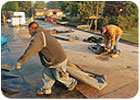
The removed EPDM membrane was folded and carried to waiting pallets on the rooftop. (Photo by Tom Hut-chinson.)
The goal of the project, as established by the EPDM industry task force, was threefold:
- To provide a recycling option for EPDM membranes currently reaching the end of their service lives, as well as for excess EPDM materials from new construction jobsites.
- To provide roof system designers motivation for specifying EPDM and procuring LEED points.
- To determine potential for reuse: What is the market demand for a product? What would be the potential con-tinuous stream of materials coming into the recycling process? What is a final determination for end-use prod-ucts?
Determining the Process
The task force met with Midwest Elastomers Inc. (MEI), a grinder of EPDM and rubber products based in Wapako-neta, Ohio. We established the likely recycling process and packaging and delivery of the materials. Perhaps most im-portantly, we also discussed potential impediments to the success of recycling aged, post-in situ EPDM roof mem-branes, such as dirt, foreign contaminants, quality of the grind, cost of recycling, continuity of the material source and need of the end product by users.While removing the EPDM membrane, the crew carefully removed debris from the top of the membrane, including stones, vegetation and tree debris. The area was swept to dry the material from the previous night’s dew or rain and remove any remaining minor contaminants.
The EPDM membrane, minus adhered flashings and lap seams, was folded and carried to waiting pallets on the roof-top. About 200 squares were removed within 15 minutes. This process continued for about six weeks, with the used EPDM membrane stacked on pallets and then delivered to MEI, which was located about 20 miles away.
On Aug. 29, 2006, the EPDM material in the pilot project was ground: under observation by the task force and MEI representatives. The first grind revealed what was described as a “typical” amount of screws, rocks and miscellaneous debris in the material. The end product produced was about 3/8 of an inch wide. About 5 percent to 7 percent of the ground material was dirt. This amount of dirt would hinder the packing process, as well as taking the process to the next stage, a second grind.
Because contaminated material would be a less desirable material to end-users and might even render it useless, this was a key point in the process. Two options are being considered:
- Future pilot tests would include a washing of the membrane, likely on the roof, before putting it through the grinder for the first time.
- During the second grind, it was found that a vacuum hood removes almost all the dirt product found in the first-grind product. This may eliminate the need for a pre-wash.
The resulting 20-mesh product was given to Carlisle SynTec and Firestone Building Products, as well as additional representatives, who are examining, evaluating and testing it for potential use in their products. Both companies have agreed to accept all recycled material for their own use, ensuring an end user throughout the project.
On-Site Packaging
The second pilot project was designed to address such concerns as on-site packaging and storage of the material, de-bris inclusion and surface foreign contaminate buildup. This project, the 809 Building in Milwaukee, was developed in association with the City of Milwaukee Department of Fleets, and the contractor, F.J.A. Christiansen Roofing Co. Inc., Milwaukee, a Tecta America company.The replacement roof system specifications called for recycling all existing materials being removed, including EPDM roofing, which would be power-washed. This will determine whether the slight cleaning of the membrane would result in a cleaner end product. The membrane has been removed from this roof, and instead of being ground, it will be sent to AdVac Elastomers, where it will be resynthesized into virgin EPDM product for reuse. As of this writ-ing, the material has not yet been shipped to AdVac, so results are pending.
EPDM roofing materials account for more than 1 billion square feet of new roof coverings in the United States each year, with more than 500,000 warranted roof installations on more than 20 billion square feet of EPDM cur-rently in place. The qualities that make EPDM membrane popular in the roofing industry - flexibility and resis-tance to various climatic conditions, including ultraviolet radiation - should make it an attractive recycled mate-rial option.
So far, the project has revealed great possibilities for the recycled product, but key logistical details remain. Per-haps the key unresolved factor is that the companies that provide synthesizers and grinders indicate they must know the volume of anticipated product during the coming years, in order to promise a certain amount of material. ERA will be working in the coming months to fill that pipeline by encouraging more building owners and contractors to provide material for recycling. We will also attempt to streamline the logistical process, by developing a list of grinders and synthesizers in various regions of the country to enable ease of delivery.
Looking for a reprint of this article?
From high-res PDFs to custom plaques, order your copy today!