Cool Roofing: New Green Roof Provides Basis for Extensive Study
Each year, green enthusiasts from all over the country - in fact, from all over the world - meet to attend the GreenBuild International Conference and Expo. They come to see new technologies that are helping to make our world more sustainable and environmentally responsible. The 2006 expo, held in Denver, was considered the largest and best-attended show of its kind ever held, and its excitement was tangible. In addition to the expo’s dramatic growth over the years, Denver had a special treat to unveil for show attendees - the opening of the city’s, and one of the country’s, greenest facilities: the new 232,000-square-foot U.S. Environmental Protection Agency (EPA) building.
Though construction was not complete at the time, the building was open to conduct special tours for show attendees. The facility, which aims to earn Gold certification under the U.S. Green Building Council’s (USGBC) Leadership in Energy and Environmental Design (LEED) rating system, was constructed with a variety of environmentally friendly and energy-saving products and materials. Photovoltaic panels and wind turbines were installed to help generate electricity, and the top of the building features a green roof.
One of the main reasons a green roof was installed, according to Jim Lindell, market development manager for Weston Solutions Inc. and GreenGrid, is because Denver has very strict stormwater runoff guidelines and restrictions. “A key feature of a Green roof is its ability to minimize stormwater runoff and meet these local requirements,” Lindell said.
Indeed, the EPA states the primary reason for the installation was to absorb precipitation after a rainfall event and release it from the building at a reduced or measured pace. However, the EPA has even bigger plans for its new green roof, and the agency intends to provide an extensive monitoring system to study the roof’s benefits. The study will provide a thorough evaluation of the green roof and its impact on the environment. The main objectives of the study include:
• Determining the capacity and capability of the green roof to minimize stormwater runoff.
• Studying its ability to filter pollutants from the air.
• Providing data, operations, and maintenance information to the city of Denver’s Urban Drainage and Flood Control District (UDFCD) about the green roof’s performance.
• Identifying areas for expanded green roof research.
Types of Green Roofs
Green roofs have been described in different ways and because of this, especially for those not directly involved or focused on green building construction and operation, the definition has been somewhat elusive. One definition that has been widely accepted states that green roofs are “protective membrane roof systems” with growth media (soil) and plant media on top to help protect the existing roof from climate fluctuations, the sun and ultraviolet rays.There are actually two different types of green roofs:
• An intensive green roof is similar to a rooftop garden, with a variety of shrubs, plants and even trees planted in several inches to several feet of soil. Just like a garden, these roofs require considerable maintenance and ongoing attention.
• An extensive green roof includes 2 to 8 inches of growth media, and is planted with sedum, grasses and other hearty, drought-resistant plants. Unlike an intensive green roof, an extensive roof requires minimal attention.
And, there are two different green roof installation styles:
• A built-in-place green roof is built in many layers directly on top of the existing roof. This system is very common, especially on older green roofs. It often involves several workers, and may take many days to weeks to install, depending on the size of the installation.
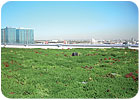
• A modular green roof system, which was used on Denver’s EPA building, was developed in just the past few years. With this system, plant and growth media are pre-planted at a nursery into modules made of 60 percent recycled plastic. They are then placed atop the roof, one after another. Less labor intensive, they are also quicker to install and still allow easy access to the underlying roof.
According to Lindell, intensive or garden roofs are usually installed more for aesthetic purposes and as a retreat for building occupants than they are for the potential benefits of a green roof system. More often, when we hear about green roofs being installed on buildings today, an extensive green roof using either the built-in-place or modular system is what is most often being described.

About the Study
To accurately and scientifically carry out the objectives of the EPA green roof study, a “control” or non-green roof was necessary. The EPA began by working with several groups to identify other buildings in the Denver area that were comparable to the new EPA building (but without a green roof) that could be used as the control location. However, for a variety of reasons, the other roofs located were either not comparable or were not directly connected to the city’s storm sewer system, which would make gauging rainfall retention and pollution very difficult.Because of this, the EPA developed a system to measure stormwater runoff directly next to the green roof. The water can be captured, as well as sampled and analyzed, for pollutants and other contaminants that would flow into the city’s sewer system. With the control in place, the EPA is taking the following steps to achieve their study objectives.
1. Determine the capacity and capability of the green roof to minimize stormwater runoff.
Rain and snowmelt will be measured from drains at both the green roof and the control roof. The system will also measure the flow rate and volume of moisture released from the green roof to determine how effectively it retains water. Additionally, information on rainfall, wind speed, humidity and temperature will be collected from both roof surfaces.
2. Study its ability to filter pollutants from the air.
To achieve this objective, the EPA found it necessary to first determine what pollutants of concern are draining from both the control and green roof. Typically, stormwater runoff from a non-green roof can include such things as sediment, oil, grease, pesticides, nutrients, viruses, bacteria, salts and other materials. Water quality samples will be taken from both roofs and analyzed. Why the concern? Stormwater runoff can become very polluted, and some localities may not always be able to treat the runoff. This means the polluted rainwater may drain into nearby rivers and streams, potentially harming aquatic life and other living things.
3. Provide data, operations and maintenance information to the City of Denver’s Urban Drainage and Flood Control District (UDFCD) about the green roof’s performance.
Although it may first appear that this objective would focus mainly on Denver’s specific concerns, the goal, along with keeping the UDFCD up-to-date, is much bigger. Indeed, it is hoped some sort of Best Management Practice (BMP) will evolve from the data that can be shared with Denver, other Colorado cities, and cities around the country. The information will also be made available to building developers regarding such items as plant selection, construction needs, and costs for the green roof operation and ongoing maintenance.
4. Identify areas for expanded green roof research.
The EPA realizes this is a significant study on green roofs, and it is opening the door with other interested parties to determine new areas of research that may also be necessary. According to the EPA, as the project moves forward, some of the areas for expanded research may include:
• Assessing plant selection, growth patterns and maintenance requirements.
• Evaluating savings from heating and cooling costs.
• Determining the effect the green roof has on the longevity of the existing roof.
• Studying the green roof’s effect on temperature swings and its ability to minimize the “urban heat island” effect that makes core cities warmer than surrounding areas.
Green roofs are quite common in Germany and other parts of Europe, as well as in Asia; however, few or only limited studies evaluating their benefits have been conducted. The Denver facility’s EPA evaluation will likely be one of the most thorough evaluations ever undertaken. “This is probably long overdue,” says Lindell. “Based on everything we already know about green roofs, it is likely this study will further the understanding of green roof systems, along with their many benefits. And for those promoting a more environmentally responsible world, this can only be good news.”
Green Roofs' Effect on Existing Roofs
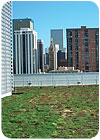
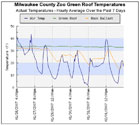
Although the testing of Denver’s EPA building has just started, some studies evaluating the various benefits of a green roof system have already begun. For instance, the Zoological Society’s new school at the Milwaukee County Zoo measures, among other things, the ambient air temperature throughout the day and compares that to the temperature of the modular green roof installed atop the existing roof.The graph in Figure 1 indicates the outdoor temperatures, the green roof temperatures, and the rock ballast temperatures recorded at various times from January 26, 2007, through February 1, 2007. Although the outdoor temperature fluctuated from a high of 40 degrees Fahrenheit (F) to a low of 2 degrees F, the green roof remained at approximately 35 degrees F, changing very little.
Temperature swings throughout the year shorten the life span of a roof. By moderating those temperatures and protecting the existing roof from ultraviolet rays, a green roof can help double an existing roof’s life span.
Looking for a reprint of this article?
From high-res PDFs to custom plaques, order your copy today!