Seminar Session: Self-Rescue Safety
Roofing Contractor safety columnist Chip Macdonald of Best Safety LLC presented the conference with a lecture and demonstration on post-arrested fall (PAF) self-rescue. The first consideration in the proper execution of a self-rescue is to avoid one whenever prudent, he stated. “Eighty-five percent of the time, performing a self-rescue is ill-advised,” said MacDonald. “And 60 percent of the time self-rescue is performed, an assisted rescue should have been conducted.”
Roofing Contractor safety columnist Chip Macdonald of Best Safety LLC presented the conference with a lecture and demonstration on post-arrested fall (PAF) self-rescue. The first consideration in the proper execution of a self-rescue is to avoid one whenever prudent, he stated. “Eighty-five percent of the time, performing a self-rescue is ill-advised,” said MacDonald. “And 60 percent of the time self-rescue is performed, an assisted rescue should have been conducted.”
He explained that while self-rescues can be quicker and place fewer personnel members at risk, they statistically result in more fatal errors in judgment. He cited injury, dehydration, inexperience and disorientation as some of the hazards that can complicate or inhibit self-rescue. The factors that determine whether a fallen roofer can perform a safe self-rescue in the event one is called for include proper planning, training and equipment.
Macdonald pointed to document A10.32-2004 of the American National Standards Institute (ANSI) and the American Society of Safety Engineers (ASSE), “Fall Protection Systems for Construction and Demolition,” which states, “A project-specific rescue plan shall be developed which will provide for a form of rescue of employees.”
He emphasized that contractors need a comprehensive written plan for each project, with provisions for rescuing PAF employees whenever they are 6 feet above a lower level (for each level), or at any height above a recognized hazard. The plan should outline procedures for rescue from all potential PAF positions under any potential site conditions. The plan also needs to define the protocol and criteria for aborting a rescue.
 “A Bic pen and paper are the best safety equipment I have,” said Macdonald, who noted that the plan should be provided in a three-ring binder at every jobsite - and that its contents should be understood by everyone at the site.
Macdonald emphasized that drafting a rescue plan is simply the first step. Any plan will be ineffective unless contractors train employees to implement it correctly.
To determine whether a self-rescue should be conducted or aborted, employees must practice good-faith PAF personal status report drills. A personal status report is a self-assessment of an employee’s psychological and physiological condition after a PAF.
It’s based on a scale of nine to one, with nine indicating maximum potential capability of rescue, a five signifying compromised strength and coordination, and a one rating denoting paralysis or unconsciousness. Macdonald asserted that personal status reports must be conducted repeatedly throughout PAF self-rescues due to the physical and mental strain they impose on the victim. If a self-rescuer’s personal status rating drops to three or below, the rescue must be aborted, and the victim should tie off and wait for assistance.
Macdonald underscored that successful self-rescue requires that employees be properly and adequately equipped with OSHA-compliant personal fall arrest systems. OSHA-certified systems are designed to safely decelerate PAF victims after a 6-foot freefall, create less than 1,800 pounds of terminal impact force on the victim and suspend the victim in a semi-vertical, orthostatic position.
Though fall protection devices can save a worker from injury, being suspended for a length of time can be harmful or even fatal. A hanging victim loses circulation and potentially fatal blood clots can form in as few as 10 to 15 minutes. To prevent or reduce suspension trauma, Macdonald recommended the UL-approved Dennington® Harness, citing its elimination of slamming or rebound effects and femoral vein garroting, and its ability to hold the victim in a true vertical arrest posture.
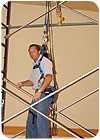
Macdonald then introduced Brent Wise, co-founder of Tech Safety Lines Inc., to demonstrate a self-rescue. Suspended in a personal arrest safety harness, Wise utilized his company’s SRK-11 self-rescue kit. The kit contains a foothold attachment, a 100-foot bag of line and a Rope Rider controlled descent device. The equipment expedites the self-rescue process, reducing suspension time and the possible resulting trauma.
Brent Wise demonstrates the automatic brake features of Tech Safety Lines’ Rope Rider controlled descent device.
Roofing Contractor safety columnist Chip Macdonald of Best Safety LLC presented the conference with a lecture and demonstration on post-arrested fall (PAF) self-rescue. The first consideration in the proper execution of a self-rescue is to avoid one whenever prudent, he stated. “Eighty-five percent of the time, performing a self-rescue is ill-advised,” said MacDonald. “And 60 percent of the time self-rescue is performed, an assisted rescue should have been conducted.”
He explained that while self-rescues can be quicker and place fewer personnel members at risk, they statistically result in more fatal errors in judgment. He cited injury, dehydration, inexperience and disorientation as some of the hazards that can complicate or inhibit self-rescue. The factors that determine whether a fallen roofer can perform a safe self-rescue in the event one is called for include proper planning, training and equipment.
Macdonald pointed to document A10.32-2004 of the American National Standards Institute (ANSI) and the American Society of Safety Engineers (ASSE), “Fall Protection Systems for Construction and Demolition,” which states, “A project-specific rescue plan shall be developed which will provide for a form of rescue of employees.”
He emphasized that contractors need a comprehensive written plan for each project, with provisions for rescuing PAF employees whenever they are 6 feet above a lower level (for each level), or at any height above a recognized hazard. The plan should outline procedures for rescue from all potential PAF positions under any potential site conditions. The plan also needs to define the protocol and criteria for aborting a rescue.
Chip Macdonald of Best Safety LLC emphasizes that it is the employer’s duty to provide proper fall protection equipment and have a written rescue plan in place at each jobsite.
Macdonald emphasized that drafting a rescue plan is simply the first step. Any plan will be ineffective unless contractors train employees to implement it correctly.
To determine whether a self-rescue should be conducted or aborted, employees must practice good-faith PAF personal status report drills. A personal status report is a self-assessment of an employee’s psychological and physiological condition after a PAF.
It’s based on a scale of nine to one, with nine indicating maximum potential capability of rescue, a five signifying compromised strength and coordination, and a one rating denoting paralysis or unconsciousness. Macdonald asserted that personal status reports must be conducted repeatedly throughout PAF self-rescues due to the physical and mental strain they impose on the victim. If a self-rescuer’s personal status rating drops to three or below, the rescue must be aborted, and the victim should tie off and wait for assistance.
Macdonald underscored that successful self-rescue requires that employees be properly and adequately equipped with OSHA-compliant personal fall arrest systems. OSHA-certified systems are designed to safely decelerate PAF victims after a 6-foot freefall, create less than 1,800 pounds of terminal impact force on the victim and suspend the victim in a semi-vertical, orthostatic position.
Though fall protection devices can save a worker from injury, being suspended for a length of time can be harmful or even fatal. A hanging victim loses circulation and potentially fatal blood clots can form in as few as 10 to 15 minutes. To prevent or reduce suspension trauma, Macdonald recommended the UL-approved Dennington® Harness, citing its elimination of slamming or rebound effects and femoral vein garroting, and its ability to hold the victim in a true vertical arrest posture.
Macdonald then introduced Brent Wise, co-founder of Tech Safety Lines Inc., to demonstrate a self-rescue. Suspended in a personal arrest safety harness, Wise utilized his company’s SRK-11 self-rescue kit. The kit contains a foothold attachment, a 100-foot bag of line and a Rope Rider controlled descent device. The equipment expedites the self-rescue process, reducing suspension time and the possible resulting trauma.
Looking for a reprint of this article?
From high-res PDFs to custom plaques, order your copy today!