Cool Roofing: Cool Metal Roofing
In the United States, buildings are responsible for almost two-thirds of national electricity consumption and more than one-third of total primary energy use. As a result, the current energy crunch has made conservation measures within these structures more important than ever.
In the United States, buildings are responsible for almost two-thirds of national electricity consumption and more than one-third of total primary energy use. As a result, the current energy crunch has made conservation measures within these structures more important than ever.
Heating and cooling costs are generally the major expenses associated with the operation of a building. Therefore, any reduction in these costs through the use of energy efficient building envelope components makes sense. Unfortunately, the roof can be the least energy efficient component of a building envelope. Is it any wonder, then, that cool roofing has become such a hot topic?
Cool roofing is gaining in popularity due to its ability to reduce cooling and heating energy usage. Utility companies are also interested in cool roofing because it can help reduce the peak demand in electricity during the afternoon hours of summer months, preventing power disruptions. And, from an environmental point of view, cool roofing can also help to mitigate a phenomenon known as the heat island effect.
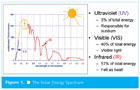
Cool roofing is based on the premise of minimizing heat gain through the roof surface. To understand how this happens, one must look at the solar energy spectrum as shown in Figure 1. Ultra violet (UV) energy in lower wavelengths amounts to only 3 percent of the total energy striking the earth's surface. Visible light energy is 40 percent and infrared (IR) energy in the longer wavelengths accounts for the largest percentage of the spectrum. When IR energy strikes the earth's surface, we feel it as heat.
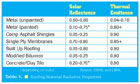
Some typical radiative properties of common roofing materials are shown in Table 1. Metal roofing has a wide range of solar reflectance and thermal emittance values. In the unpainted condition, a metallic surface has a very low TE but a relatively high TSR. When a paint system is applied to the surface, the TE is very high regardless of the color. However, the TSR can vary depending on the color and/or pigmentation used.
These policies can be national and local programs, each with their own unique criteria and definitions of cool roofing. Most of the programs are voluntary, but some have mandatory criteria. They often pertain to both low and steep slope roofing.
EPA estimates that an ENERGY STAR-labeled roof can lower a roof temperature by as much as 100 degrees Fahrenheit. The lower surface temperature translates into lower heat flow into the attic space below the roof and reduces the load on the air cooling system. To date, more than 60 percent of the products listed on the ENERGY STAR-labeled directory are metal roofing products or coatings used specifically in the metal roofing industry.
The Cool Roof Rating Council (CRRC) is now recognized by the CEC as the sole entity responsible for labeling roofing products that are allowed in the California Energy Code Title 24. It is important to note that the CRRC does not establish criteria or definitions for cool roofing.
California is leading the way with an energy code as part of its overall building code. The latest version of Title 24 became effective in October 2005. For the first time, this version of the energy code contains language specific to cool roofing requirements.
Compliance with Title 24 is based on meeting prescriptive requirements of 0.70 TSR, 0.75 TE and being a CRRC-listed product. Compliance can also be achieved using a method of building component tradeoffs and energy budgets. The current code pertains only to non-residential conditioned buildings with a low slope roof. The impact on metal roofing is that unpainted metal such as Galvalume sheet cannot comply with the prescriptive criteria. However, compliance using the tradeoff calculations is possible, but costly.
The Energy Policy Act of 2005 includes tax incentives for commercial construction. An eligible commercial contractor can receive a tax deduction equivalent to $1.80 for every square foot of the building, if the building is designed to conserve energy. The use of energy efficient building envelope components is required, and a cool metal roof can be used to lower the cooling energy use in the building.
Metal roofing may also contribute to the LEED (www.usgbc.org) rating system in several categories. Its high recycled content can be used to raise the overall building's average recycled content in order to receive up to two points. Supplying a metal panel from a location within 500 miles of a jobsite can contribute to a point for regional manufacturer. The fact that metal is 100 percent recyclable helps with the waste management section of LEED. One credit can be awarded for metal in the Heat Island Roof section where cool roofing is defined.
For cooler climates where heating dominates, a lower TE may be desirable which can be met with an unpainted metal roof. In contrast, in warmer climates where cooling loads dominate, a high TSR and TE is desirable which can be met with a pre-painted metal surface using lighter colors and/or IR reflective pigmentation. This design flexibility, combined with the sustainability, strength, durability, and low lifecycle cost makes metal roofing a cool choice for any building.
Cool coated roof on Louisville Slugger Field. Photo courtesy of The Metal Initiative.
In the United States, buildings are responsible for almost two-thirds of national electricity consumption and more than one-third of total primary energy use. As a result, the current energy crunch has made conservation measures within these structures more important than ever.
Heating and cooling costs are generally the major expenses associated with the operation of a building. Therefore, any reduction in these costs through the use of energy efficient building envelope components makes sense. Unfortunately, the roof can be the least energy efficient component of a building envelope. Is it any wonder, then, that cool roofing has become such a hot topic?
Cool roofing is gaining in popularity due to its ability to reduce cooling and heating energy usage. Utility companies are also interested in cool roofing because it can help reduce the peak demand in electricity during the afternoon hours of summer months, preventing power disruptions. And, from an environmental point of view, cool roofing can also help to mitigate a phenomenon known as the heat island effect.
Cool roofing is based on the premise of minimizing heat gain through the roof surface. To understand how this happens, one must look at the solar energy spectrum as shown in Figure 1. Ultra violet (UV) energy in lower wavelengths amounts to only 3 percent of the total energy striking the earth's surface. Visible light energy is 40 percent and infrared (IR) energy in the longer wavelengths accounts for the largest percentage of the spectrum. When IR energy strikes the earth's surface, we feel it as heat.
KEEP COOL The reflectance values of metal roofing systems can reduce energy use. (Photo courtesy of The Metal Initiative.)
Coming to Terms with Cool Roofing
Cool roofing is described by two main terms: solar reflectance and thermal emittance. Total solar reflectance (TSR) is the percentage of all solar radiation that is immediately reflected from a surface. Any energy that is not reflected from a surface is absorbed by the material. Some of this is transferred to heat, which can be removed by convective transfer from air flow over the surface. Some of the heat can be conducted through the surface. More importantly, some of the heat can be re-emitted to the night sky in the form of infrared wavelength energy. The latter phenomenon is known as thermal emittance (TE). The combination of solar reflectance and thermal emittance properties of a material determine the surface temperature of a roof and its ability to act cool.Some typical radiative properties of common roofing materials are shown in Table 1. Metal roofing has a wide range of solar reflectance and thermal emittance values. In the unpainted condition, a metallic surface has a very low TE but a relatively high TSR. When a paint system is applied to the surface, the TE is very high regardless of the color. However, the TSR can vary depending on the color and/or pigmentation used.
Figure 1. The Solar Energy Spectrum
Variety of Voluntary and Mandatory Programs
In addition to the obvious energy saving benefits of cool roofing to a building owner, its use is also influenced by codes, standards, rebate/incentives, or marketing programs. And, in this regard, the landscape is bursting with an ever-increasing list of cool roofing programs and initiatives.These policies can be national and local programs, each with their own unique criteria and definitions of cool roofing. Most of the programs are voluntary, but some have mandatory criteria. They often pertain to both low and steep slope roofing.
EPA estimates that an ENERGY STAR-labeled roof can lower a roof temperature by as much as 100 degrees Fahrenheit. The lower surface temperature translates into lower heat flow into the attic space below the roof and reduces the load on the air cooling system. To date, more than 60 percent of the products listed on the ENERGY STAR-labeled directory are metal roofing products or coatings used specifically in the metal roofing industry.
The Cool Roof Rating Council (CRRC) is now recognized by the CEC as the sole entity responsible for labeling roofing products that are allowed in the California Energy Code Title 24. It is important to note that the CRRC does not establish criteria or definitions for cool roofing.
California is leading the way with an energy code as part of its overall building code. The latest version of Title 24 became effective in October 2005. For the first time, this version of the energy code contains language specific to cool roofing requirements.
Compliance with Title 24 is based on meeting prescriptive requirements of 0.70 TSR, 0.75 TE and being a CRRC-listed product. Compliance can also be achieved using a method of building component tradeoffs and energy budgets. The current code pertains only to non-residential conditioned buildings with a low slope roof. The impact on metal roofing is that unpainted metal such as Galvalume sheet cannot comply with the prescriptive criteria. However, compliance using the tradeoff calculations is possible, but costly.
The Energy Policy Act of 2005 includes tax incentives for commercial construction. An eligible commercial contractor can receive a tax deduction equivalent to $1.80 for every square foot of the building, if the building is designed to conserve energy. The use of energy efficient building envelope components is required, and a cool metal roof can be used to lower the cooling energy use in the building.
Metal roofing may also contribute to the LEED (www.usgbc.org) rating system in several categories. Its high recycled content can be used to raise the overall building's average recycled content in order to receive up to two points. Supplying a metal panel from a location within 500 miles of a jobsite can contribute to a point for regional manufacturer. The fact that metal is 100 percent recyclable helps with the waste management section of LEED. One credit can be awarded for metal in the Heat Island Roof section where cool roofing is defined.
Table 1. Roofing Material Radiative Properties
Metal Roofing: a Cool Choice for Any Building
With its wide range of TSR/TE properties, metal roofing can be engineered to optimize the energy efficiency of a roof system depending on the climate and application.For cooler climates where heating dominates, a lower TE may be desirable which can be met with an unpainted metal roof. In contrast, in warmer climates where cooling loads dominate, a high TSR and TE is desirable which can be met with a pre-painted metal surface using lighter colors and/or IR reflective pigmentation. This design flexibility, combined with the sustainability, strength, durability, and low lifecycle cost makes metal roofing a cool choice for any building.
Links
Looking for a reprint of this article?
From high-res PDFs to custom plaques, order your copy today!