As China Takes Center Stage with the Beijing Olympic Games: China's Roofing and Waterproofing Industry Moves Forward
A series of fortunate events allowed me to represent Roofing Contractor
on a recent trip to China. It began with the recent addition of a
non-stop flight from my hometown of Atlanta to Shanghai, which greatly
reduced the expense and hassle of getting there. Yes, a 15-hour flight
followed by a 12-hour time difference was challenging, but not nearly
as bad as a three-leg journey taking nearly 24 hours.

A series of fortunate events allowed me to represent Roofing Contractor on a recent trip to China.
It began with the recent addition of a non-stop flight from my hometown of Atlanta to Shanghai, which greatly reduced the expense and hassle of getting there. Yes, a 15-hour flight followed by a 12-hour time difference was challenging, but not nearly as bad as a three-leg journey taking nearly 24 hours. Upon learning the 6th Annual Roofing and Waterproofing Expo was set to be held in Shanghai, the idea of traveling to China started to make sense. Add to that, there is a great deal of interest in China with the continuing strong economic growth and the staging of the 2008 Beijing Olympics.
The deal was sealed by the kind invitation of my good friend, Mr. G.Q. Zhao, to visit with him and his associates at the China Building Waterproofing (CBW) magazine office in Suzhou located just a few hours outside of Shanghai.
This report is but an outline of a 10-day journey to China that included a visit to the site of the primary Olympic venues, the Expo, the CBW magazine office, and the Suzhou Waterproof Material Research and Design Institute.
If you can read Mandarin and prefer to get more information on the roofing and waterproofing industry in China, you may also check out the CBW Website at www.jzfsonline.com.
Expo attendees were treated to an excellent trade show consisting of two distinct levels. On the main floor, larger manufacturers and distributors of materials and equipment featured their goods. In addition to the Chinese manufacturers of roofing and waterproofing materials and equipment, a number of U.S., European, and Japanese firms were represented.
We noted the presence of Johns Manville, Atlas Roofing Corporation, Sika/Sarnafil, Soprema, BASF, Graco, Firestone, Carlisle, Reichel & Drews, and SFS Intec, to name just a few.
 Johns-Manville had representatives at the Expo who were in China on a
mission to train installers. Ian Barrow with Atlas Roofing Products was there
with an associate to continue the job of promoting polyiso roof insulation.
Barrow reports progress but is a bit frustrated by the standards that have been
adopted for roof insulation in China. It seems that they measure roof
insulation by the inch, no matter the type of insulation. An inch of a polyiso
insulation is considered equal to an inch of mineral wool insulation. The
Chinese are beginning to focus on energy efficiency in construction, so this
may change in the future.
The second floor consisted of a wide variety of suppliers of
accessory products and building waterproofing products from smaller, mostly
domestic, providers.
Johns-Manville had representatives at the Expo who were in China on a
mission to train installers. Ian Barrow with Atlas Roofing Products was there
with an associate to continue the job of promoting polyiso roof insulation.
Barrow reports progress but is a bit frustrated by the standards that have been
adopted for roof insulation in China. It seems that they measure roof
insulation by the inch, no matter the type of insulation. An inch of a polyiso
insulation is considered equal to an inch of mineral wool insulation. The
Chinese are beginning to focus on energy efficiency in construction, so this
may change in the future.
The second floor consisted of a wide variety of suppliers of
accessory products and building waterproofing products from smaller, mostly
domestic, providers.
The products shown in the Expo were primarily low-slope membrane and waterproofing materials with a minority presence of equipment providers and asphalt shingle manufacturers. Asphalt shingle production and sales continue to grow in China but face stiff competition from other steep-slope products. This particular Expo did not feature metal roofing or steep-slope “hard” roofing products such as slate or tile. There is quite a bit of slate quarried in China, and the use of tile and metal roofing is predominant in many areas, but the division of construction products and disciplines takes a different course here than it does in the U.S. and other parts of the world.
In addition to the trade show, numerous technical and product seminars were conducted. Two worthy of note were presentations given by FM Approvals’ George Smith and a technical presentation by representatives of Soprema that were translated from English for the Chinese audience by our friend, Mr. Zhao. Zhao’s longtime associate and former classmate, Mrs. Junzhu Xu, is a senior consultant for Soprema. Known to her associates as “Xu Mum”, Mrs. Xu made sure this visitor from the USA always had an interpreter available and even made sure no meals were missed. Soprema provided much of the waterproofing on the buildings and plaza decks of the Olympic Green, the primary site of the 2008 Olympics in Beijing.
The architect for the National Stadium, also known as “The Bird’s Nest”, was also the architect for the Suzhou Science and Cultural Arts Center. Xu Mum arranged for a tour of the facility that features a garden roof over a parking deck that includes ponds, wooden decks, and all manners of shrubs and trees. Soprema also furnished the waterproofing on this facility. While growing a robust materials manufacturing industry, the Chinese have embraced partnerships with manufacturers from around the world. U.S., Japanese, and European manufacturers are involved in joint ventures to ship materials into China as well as manufacture in China for the local and export markets.
Of course, the type of government is quite different than ours. The chain of ownership, contracts, assumption of risk, design, codes, material standards, testing, and inspections all exist in varying levels, but in an entirely different way from those found in the U.S. You have to remember that OSHA and the IRS do not exist in China. They do have government oversight, but it is quite different. The terms and scope of “employee” or “subcontractor,” such as we would recognize them. are simply foreign.
As for the division of work among the trades, it does not appear to have taken form as of yet.
Large construction concerns frequently handle design through completion without the use of (what we would call) subcontractors. This is, however, becoming a point of concern for some contractors that we spoke with while at the Expo. They seek to specialize in roofing and waterproofing and offer their services to the larger contractors. Their selling point: we can do the job better giving you a lower overall cost and fewer headaches down the road. A novel approach in China, but as the economy continues to mature the demands of owners are bound to become more sophisticated. Historically, many owners’ expectation of a roof life is as low as five years. In some cases the occasional leak is anticipated, even expected.
On the other hand, asphalt shingle growth is slow because of the perception that shingles are not long lasting like tile. Considering the labor differential, the installed cost difference between asphalt shingles and tile in China may not be as great as it is in the West.

The Institute, headed by Mr. Xian Yongbiao, is affiliated with the China Building Materials Academy and is wholly owned by China Building Material Waterproof Materials Company. The Institute is mainly engaged in research and development of roofing and waterproofing materials, promotion and application of new products and new technologies, as well as design, installation and start-up of bitumen membrane production lines with capacities ranging from 5 to 10 million square meters.
The Institute has a variety of missions, including inspections. Part of the Institute, the Building Waterproofing Materials Supervision and Inspection Center is a state-authorized third-party statutory inspection body. It is the largest such enterprise in China. There are a variety of testing labs at the location and include labs for coatings, cements, hazardous materials (VOC’s for example), rigid materials, insulation, and asphalt shingles. A set of standards for asphalt shingles was only recently implemented.
The Institute is broken into four main groups: Research and Development, Inspection, Design, and Communication (China Building Waterproofing magazine).
China Building Waterproofing magazine is jointly managed by CBMWMC and CNWBMIA. Mrs. Xu Jianyue heads CBW; who took over the publication when it moved in 1987 from Beijing to Suzhou.
CBW started as a quarterly and grew step-by-step into a monthly publication. In discussions with Mrs. Xu and her staff, it was discovered that there were both many similarities and many contrasts in our publications. CBW has a base of around 8,500 paid subscribers that include building owners, designers, contractors, and universities. Roofing Contractor is edited primarily for the contractor and has a subscriber base nearly three times as large, but is delivered free to roofing contractors and is supported almost completely by advertisers. CBW also sells and features advertising and is the sole such publication for roofing and waterproofing in China.
The focus for CBW is technical editorial and includes regular features on underground works and tunnels, road and bridge, technology and equipment, overseas waterproofing (includes reports from the U.S), building construction, standards and inspections, and “Voice of the CNWBMIA” - a report on association activities.
CBW staffers were most interested in how Roofing Contractor is put together each month, as well as the type of editorial we feature. Their publication leans toward the technical side, like our sister publication, Architectural Roofing & Waterproofing. They were also interested in learning more about the kind of editorial we publish aimed at roofing contractors, such as issues of sales, operations, and worker safety. There is a growing demand for information at the contractor level and this talented group of individuals seems interested in providing it for the China market and possibly other Asian markets.
Work at the Institute touches all facets of the building waterproofing industry in China. In addition to the responsibility for standardization of materials and the development of codes, the main job of the Institute is inspection of building waterproofing products. These inspections include not only inspections of the products themselves, but also jobsite inspections, which the Institute performs all over China. Still being developed by the Institute are methods to deliver worker training in order to assure quality installations. According to Director Xian, the plan is to adopt systems comparable to those used in Europe and the USA.
The Director tells us the Institute takes direction from the central government by way of initiatives that stem from “The Five-Year Plan”. There has been a succession of five-year plans and the model currently being worked is the 11th in the series. The 11th five-year plan is due to be completed by 2010. That is to say, all initiatives developed for the plan must be instituted by then. The primary thrust of the 11th five-year plan is energy conservation, so the focus is on greening of rooftops and roof insulation. Perhaps this will hasten a move to higher R-value roof insulation materials?
Suzhou is a modern, bustling metropolis, but has a long history dating back to ancient China. Famous for its gardens, Suzhou is a favorite tourist destination in China. The directors and staff treated the writer to one of the finest meals of the trip; lunch in a famous Suzhou restaurant that featured several unique seafood dishes and some of the best pork this side of Memphis.

The Beijing Oriental Wuhong Waterproof Technology Company, Ltd furnished our driver, Mr. Wan. The Wuhong firm hosted a group from the USA traveling there as part of an NRCA study tour to China in 2004. The visit included a visit to their modified bitumen plant and a tour of the museum of the building waterproofing industry in China. A report on that tour may be found at: www.roofingcontractor.com/Articles/Feature_Article/e510189ac3c58010VgnVCM100000f932a8c0.
Just adjacent to the plaza is a complex of five new buildings that resemble a Chinese dragon and includes office, hotel, and residential spaces. The distinctive design will bring quite a bit of attention to the area for many years to come as it is seen most clearly from the ring road that leads to the venue. Among the unique features of the building is a helipad on the end building. We learned at the Expo that Beijing Kalairulyu Waterproofing Materials Co., Ltd., an installer for Carlisle (U.S.) furnished the roofing for most of the project. The Kalairulyu venture has assumed manufacturing of some Carlisle products in China. The Chinese dragon theme is continued with a man-made water feature shaped like a dragon adjacent to the plaza and the various curves on the Beijing 2008 Olympic logo is said to symbolize the Chinese dragon.
While the dragon buildings will catch some attention, the National Stadium, also known as “The Birds Nest,” will captivate the world that will tune into the TV presentation of the Olympic games. Here is where the opening and closing ceremonies will be held and many of the track and field events will be contested. The unique stadium is surrounded by a series of steel girders arranged to resemble twigs in a bird’s nest. The Swiss firm, Herzog and deMeupon working with Chinese architect, Li Xinggang, designed it. They joined with the Chinese artist, Al Weiwei, who served as the “stylistic consultant”.
The National Indoor Stadium is the most conservative of the buildings on this site, but boasts a clean look topped by a sweeping roof- line that fits snugly into its surroundings. The National Aquatic Center, known by locals as “The Water Cube,” is at once a plain, rectangular building, but with a surface of bubbles and a see-through skin.
We learned from our friends at CBW that 31 of the 37 venues were constructed (or rebuilt) in Beijing. The editors of CBW have contributed this portion of this feature.
The owners of the venues and facilities attached great importance to waterproofing and anti-seepage and the most advanced materials and technologies available at home and abroad were used. An advisory group having top experts in the industry in China called for many discussions and examinations concerning waterproofing and anti-seepage design, construction and inspection. The newly built venues include the National Stadium (Bird Nest), National Indoor Stadium, National Aquatics Center (The Water Cube) and National Conference Center in the center zone. The south zone includes Olympic Sports Center Stadium, Ying Tung Natatorium and the south zone has Olympic Forest Garden, Tennis Center, Hockey Field and Archery Field. Some venues are scattered including Beijing University Gymnasium, China Agricultural University Gymnasium. The Beijing Olympic venues are large in span and space and complicated in structure. The areas needing waterproofing total 8 million square meters, including roofs, a man-made lake, man-made wetland and water park. Lightweight environmentally friendly materials, which have multiple functions of waterproofing, insulating, providing quality acoustics, and aesthetically pleasing, were selected for roofs of all venues.
You may, however, be amazed by the things you have missed out on by not traveling around the world. As globalization moves on and the world continues to shrink, I firmly believe that firsthand knowledge of other peoples and other cultures will serve you and your business well in the years to come. Even if that is not the case, you can still enjoy a most pleasant travel experience. I certainly have; and if the Lord is willing I will again.
Mr. G.Q. Zhao and the editors of China Building Waterproofing contributed to this report
Waterproofing roof systems used are as follows:
1. Sheet metal plus membrane
2. Standing seam metal
3. Mechanically fastened reinforced PVC
4. ETFE membrane
5. Spray or brush polyurea elastomer
6. Na-based bentonite carpet
7. HDPE geotextile
8. Self-waterproof concrete plus membrane
9. Planted roof with puncture resistant membrane
System 1 sheet plus membrane used for the National Indoor Stadium:
3 mm polymer modified bitumen self- adhered membrane plus 1 mm Al, Mg, Mn alloy sheet are used for waterproofing and drainage system. The Gymnasium is 212.5 m long (S-N) and 122.5 m wide (E-W), the highest elevation 43 m, total floor area 81000 m2, seats 18000, roof area 24000 m2.
Roof structure (downwards)
0.9 mm AlMgMn standing seam alloy sheet
30 mm 48 Kg /m3 acoustic wool
3 mm self- adhered SBS membrane
8 mm pressed cement board
00 mm 120Kg /m3 mineral wool
8 mm pressed cement board
80 Kg /m3 acoustic wool
0.75 mm roll-formed sheet (915 mm wide)
25 mm fibre spray acoustic material
Application details: (above pressed cement board only)
Pressed cement board is used as substrate for self-adhered membrane, clean and dry
The substrate surface is treated with Special primer
Place self-adhered membrane and pat special attention to overlap and T-type support
Install site-formed alloy sheet, supported by T-type support. Adjacent sheets are interlocked and treated with special machine.
Beijing University Gymnasium
1.5 mm EPDM plus 0.9 mm AlMgMn alloy sheet are used for waterproofing and drainage system. Total floor area is 26900 m2, the highest elevation 31.3 m, seats 8000, and roof area 10000 m2. The roof shapes like rotating PingPang ball.
Roof structure (downwards)
0.9 mm AlMgMn alloy sheet
Mineral wool
1.5 mm EPDM
50 mm extruded insulation
0.3 mm PE film
1 mm galvanized steel sheet
50 mm acoustic wool
Non-woven fabric
0.5 mm colored corrugated AlZn planted sheet
Application details: (above 1 mm galvanized steel sheet only)
Place 0.3 mm PE film on clean dry galvanized sheet with overlap width 100 mm up
Two layers of 50 mm extruded polystyrene and joints in the two layers should be staggered
Loose laid for membrane in plane and fully adhered for others.
Special adhesive is used for overlap and sealant used as well. Pay more attention to T-type supports. See Photos.
Alloy sheet installation same as mentioned above
National Stadium and National Aquatics Stadium use FTFE (copolymer of ethylene-tetrafluoroethylene) membrane system.
National Stadium
Steel roof with area of 60000 m2, one layer of FTFE membrane tensioned in on the top as waterproof layer and one layer of FTFE membrane on the bottom as decorative and acoustic ceiling.
National Aquatics Stadium
Its roof and walls consist of more than 30000 air pillows made of FTFE membrane with various size and shapes, totaling area of 100000 m2 (roof and walls)
Stands of both Olympic Sports Center Stadium and Baseball Field adopt polyurea elastomer as waterproof, wear-resistant and deco layer.
Its structure:
1.2 mm spray polyurea
20 mm polymer fibre reinforced cement mortar protection
1.5 mm polymey cement coating
Concrete stand
Man-Made Marsh and Lake
Na-based bentonite carpet for anti-seepage
The carpet is used in man-made marsh, man-made lake and dragon-shaped water system, totaling area of one million m2. Structure:
Water body
Earth for planting, ≥400
Protection, ≥300
Bentonite carpet
Compacted earth, compacting factor 0.9
Olympic Water Park is 3000 m long (S-N direction) and 900 m wide (E-W direction) with depth of 2-5 m. Total area is 700000 m2. To prevent water loss due to seepage, HDPE (high-density polyethylene) membrane is used to form monolithic layer by welding.
Structure:
Prefabricated concrete plate
Hard mortar layer
Compacted earth
Non-woven fabric
HDPE anti-seepage layer
Non-woven fabric
Compacted earth
Olympic Green covers many venues and has underground traffic channels connecting all parking lots of the venues and commercial center. This is the broad plaza area adjacent to the National Indoor and Outdoor Stadiums as well as the National Aquatic Stadium. When you see the venues on the televised reporting of the Olympics, you will know there is a virtual city beneath the plaza and parts of the other structures. The channel is 15 to 25 m deep, 16 to 25 m wide with clear height of 5 m and total length of 9.87 Km. Due to its importance, “A” level is specified for its waterproofing, i.e. no seepage and no water stain allowed. The channel is made of waterproof concrete with compressive strength of C30-40 and impermeability of P8. Its positive side is fully covered by double layer of 4 m polyester reinforced SBS membrane. The details such as movement joint, construction joint and inside corners and outside corners are waterproofed with various waterproofing materials and combined ways. The total area waterproofed is 500000 m2. Winter and raining season prove its good quality.
Planted roof with puncture resistant membrane
Roofs of underground commercial center, channel and parking lots, totaling 250000 m2, are waterproofed as required for planted roof.
Structure:
Vegetation
Growth media
Filter
Drainage
Protection
Root and puncture resistant membrane
4 mm polyester reinforced SBS membrane
Leveling
Deck
Details:
1.Modified bitumen is brushed on clean, dry leveling layer
2. SBS membrane is torch-applied after above brushed bitumen is dried.
3. Also the root and puncture resistant membrane is torch-applied. Seams of the two membrane layers should staggered 1/3 to 1/2 width of the membrane.
The following is the author’s view of the overall Olympic projects (translated from the original version in Chinese): “Since the most advanced waterproofing materials and techniques are used in Olympic venues and great efforts made by all parties concerned, the waterproofing quality of the venues is good in general. However, some issues should be probed such as sheet steel on metal roof is too thin (0.6 mm) so that deformation may easily occur. It is not easy to clean up surfaces of ETFE membrane and its air pillow roof and wall.”
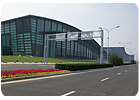
Seen
beyond some of the shrubs, trees, and flowers that run along a nearby road in Beijing are the National
Outdoor Stadium (known as the “Bird’s Nest”) on the left and the National
Aquatics Stadium (called the “Water Cube”) on the right.
A series of fortunate events allowed me to represent Roofing Contractor on a recent trip to China.
It began with the recent addition of a non-stop flight from my hometown of Atlanta to Shanghai, which greatly reduced the expense and hassle of getting there. Yes, a 15-hour flight followed by a 12-hour time difference was challenging, but not nearly as bad as a three-leg journey taking nearly 24 hours. Upon learning the 6th Annual Roofing and Waterproofing Expo was set to be held in Shanghai, the idea of traveling to China started to make sense. Add to that, there is a great deal of interest in China with the continuing strong economic growth and the staging of the 2008 Beijing Olympics.
The deal was sealed by the kind invitation of my good friend, Mr. G.Q. Zhao, to visit with him and his associates at the China Building Waterproofing (CBW) magazine office in Suzhou located just a few hours outside of Shanghai.
This report is but an outline of a 10-day journey to China that included a visit to the site of the primary Olympic venues, the Expo, the CBW magazine office, and the Suzhou Waterproof Material Research and Design Institute.
If you can read Mandarin and prefer to get more information on the roofing and waterproofing industry in China, you may also check out the CBW Website at www.jzfsonline.com.
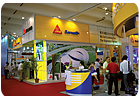
The
Sika-Sarnafil booth at the Sixth China Roofing and Waterproofing Expo in Shanghai.
China Roofing and Waterproofing Expo 2008
The China National Waterproof Building Materials Industry Association (CNWBMIA); the China National Building Materials Group Corporation (CNBMGC); and the National Roofing Contractors Association (NRCA) sponsored the China Roofing & Waterproofing Expo 2008. NRCA has been actively supporting the Chinese roofing and building waterproofing industry for a number of years. The Expo has grown into an annual event and is attended by industry principals including material manufacturers, distributors, designers, and contractors.Expo attendees were treated to an excellent trade show consisting of two distinct levels. On the main floor, larger manufacturers and distributors of materials and equipment featured their goods. In addition to the Chinese manufacturers of roofing and waterproofing materials and equipment, a number of U.S., European, and Japanese firms were represented.
We noted the presence of Johns Manville, Atlas Roofing Corporation, Sika/Sarnafil, Soprema, BASF, Graco, Firestone, Carlisle, Reichel & Drews, and SFS Intec, to name just a few.
This
series of five buildings adjacent to the Olympic plaza in Beijing were designed to have the appearance
of the Chinese dragon. A Chinese-based joint venture with Carlisle
furnished the EPDM roofing.
The products shown in the Expo were primarily low-slope membrane and waterproofing materials with a minority presence of equipment providers and asphalt shingle manufacturers. Asphalt shingle production and sales continue to grow in China but face stiff competition from other steep-slope products. This particular Expo did not feature metal roofing or steep-slope “hard” roofing products such as slate or tile. There is quite a bit of slate quarried in China, and the use of tile and metal roofing is predominant in many areas, but the division of construction products and disciplines takes a different course here than it does in the U.S. and other parts of the world.
In addition to the trade show, numerous technical and product seminars were conducted. Two worthy of note were presentations given by FM Approvals’ George Smith and a technical presentation by representatives of Soprema that were translated from English for the Chinese audience by our friend, Mr. Zhao. Zhao’s longtime associate and former classmate, Mrs. Junzhu Xu, is a senior consultant for Soprema. Known to her associates as “Xu Mum”, Mrs. Xu made sure this visitor from the USA always had an interpreter available and even made sure no meals were missed. Soprema provided much of the waterproofing on the buildings and plaza decks of the Olympic Green, the primary site of the 2008 Olympics in Beijing.
The architect for the National Stadium, also known as “The Bird’s Nest”, was also the architect for the Suzhou Science and Cultural Arts Center. Xu Mum arranged for a tour of the facility that features a garden roof over a parking deck that includes ponds, wooden decks, and all manners of shrubs and trees. Soprema also furnished the waterproofing on this facility. While growing a robust materials manufacturing industry, the Chinese have embraced partnerships with manufacturers from around the world. U.S., Japanese, and European manufacturers are involved in joint ventures to ship materials into China as well as manufacture in China for the local and export markets.
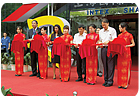
The
ribbon-cutting ceremony for the Sixth China Roofing and Waterproofing Expo was
an event in itself.
Getting the Job Done in China
Roofing Contractor was interested in learning how the construction and roofing process evolves in China. While not coming away with a firm view of how it all works, a number of things were learned about how buildings are waterproofed in China. First, you must throw out any notion of the way construction is done in the U.S.Of course, the type of government is quite different than ours. The chain of ownership, contracts, assumption of risk, design, codes, material standards, testing, and inspections all exist in varying levels, but in an entirely different way from those found in the U.S. You have to remember that OSHA and the IRS do not exist in China. They do have government oversight, but it is quite different. The terms and scope of “employee” or “subcontractor,” such as we would recognize them. are simply foreign.
As for the division of work among the trades, it does not appear to have taken form as of yet.
Large construction concerns frequently handle design through completion without the use of (what we would call) subcontractors. This is, however, becoming a point of concern for some contractors that we spoke with while at the Expo. They seek to specialize in roofing and waterproofing and offer their services to the larger contractors. Their selling point: we can do the job better giving you a lower overall cost and fewer headaches down the road. A novel approach in China, but as the economy continues to mature the demands of owners are bound to become more sophisticated. Historically, many owners’ expectation of a roof life is as low as five years. In some cases the occasional leak is anticipated, even expected.
On the other hand, asphalt shingle growth is slow because of the perception that shingles are not long lasting like tile. Considering the labor differential, the installed cost difference between asphalt shingles and tile in China may not be as great as it is in the West.
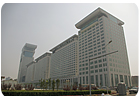
The
National Outdoor Stadium and plaza deck were built over parking decks and
buildings.
A Visit to the Institute and the Magazine Office
A great day was spent making new acquaintances and speaking about roofing and waterproofing at the Suzhou Waterproof Material Research and Design Institute, also known as “The Institute”.The Institute, headed by Mr. Xian Yongbiao, is affiliated with the China Building Materials Academy and is wholly owned by China Building Material Waterproof Materials Company. The Institute is mainly engaged in research and development of roofing and waterproofing materials, promotion and application of new products and new technologies, as well as design, installation and start-up of bitumen membrane production lines with capacities ranging from 5 to 10 million square meters.
The Institute has a variety of missions, including inspections. Part of the Institute, the Building Waterproofing Materials Supervision and Inspection Center is a state-authorized third-party statutory inspection body. It is the largest such enterprise in China. There are a variety of testing labs at the location and include labs for coatings, cements, hazardous materials (VOC’s for example), rigid materials, insulation, and asphalt shingles. A set of standards for asphalt shingles was only recently implemented.
The Institute is broken into four main groups: Research and Development, Inspection, Design, and Communication (China Building Waterproofing magazine).
China Building Waterproofing magazine is jointly managed by CBMWMC and CNWBMIA. Mrs. Xu Jianyue heads CBW; who took over the publication when it moved in 1987 from Beijing to Suzhou.
CBW started as a quarterly and grew step-by-step into a monthly publication. In discussions with Mrs. Xu and her staff, it was discovered that there were both many similarities and many contrasts in our publications. CBW has a base of around 8,500 paid subscribers that include building owners, designers, contractors, and universities. Roofing Contractor is edited primarily for the contractor and has a subscriber base nearly three times as large, but is delivered free to roofing contractors and is supported almost completely by advertisers. CBW also sells and features advertising and is the sole such publication for roofing and waterproofing in China.
The focus for CBW is technical editorial and includes regular features on underground works and tunnels, road and bridge, technology and equipment, overseas waterproofing (includes reports from the U.S), building construction, standards and inspections, and “Voice of the CNWBMIA” - a report on association activities.
CBW staffers were most interested in how Roofing Contractor is put together each month, as well as the type of editorial we feature. Their publication leans toward the technical side, like our sister publication, Architectural Roofing & Waterproofing. They were also interested in learning more about the kind of editorial we publish aimed at roofing contractors, such as issues of sales, operations, and worker safety. There is a growing demand for information at the contractor level and this talented group of individuals seems interested in providing it for the China market and possibly other Asian markets.
Work at the Institute touches all facets of the building waterproofing industry in China. In addition to the responsibility for standardization of materials and the development of codes, the main job of the Institute is inspection of building waterproofing products. These inspections include not only inspections of the products themselves, but also jobsite inspections, which the Institute performs all over China. Still being developed by the Institute are methods to deliver worker training in order to assure quality installations. According to Director Xian, the plan is to adopt systems comparable to those used in Europe and the USA.
The Director tells us the Institute takes direction from the central government by way of initiatives that stem from “The Five-Year Plan”. There has been a succession of five-year plans and the model currently being worked is the 11th in the series. The 11th five-year plan is due to be completed by 2010. That is to say, all initiatives developed for the plan must be instituted by then. The primary thrust of the 11th five-year plan is energy conservation, so the focus is on greening of rooftops and roof insulation. Perhaps this will hasten a move to higher R-value roof insulation materials?
Suzhou is a modern, bustling metropolis, but has a long history dating back to ancient China. Famous for its gardens, Suzhou is a favorite tourist destination in China. The directors and staff treated the writer to one of the finest meals of the trip; lunch in a famous Suzhou restaurant that featured several unique seafood dishes and some of the best pork this side of Memphis.
Pictured
from left are Xu Jianyue, Head of Magazine and Senior Editor of China Building
Waterproofing, Rick Damato,
Editorial Director of Roofing Contractor, Xian Yongbiao, Director of the Suzhou
Institute of Research and Design in Waterproofing Materials. (Photo courtesy of
CBW.)
The World Comes to Beijing
Beijing is a short flight from Shanghai and the leader of the CNWBMIA, Dongqing Zhu, graciously arranged for one of his staffers to take me for a tour of the primary Olympic venue. Ms. Julia Lu was my escort and translator for a walking tour of the Olympic Green, the main plaza that is surrounded by the National Stadium, the National Aquatic Centre, and the National Indoor Stadium.The Beijing Oriental Wuhong Waterproof Technology Company, Ltd furnished our driver, Mr. Wan. The Wuhong firm hosted a group from the USA traveling there as part of an NRCA study tour to China in 2004. The visit included a visit to their modified bitumen plant and a tour of the museum of the building waterproofing industry in China. A report on that tour may be found at: www.roofingcontractor.com/Articles/Feature_Article/e510189ac3c58010VgnVCM100000f932a8c0.
Just adjacent to the plaza is a complex of five new buildings that resemble a Chinese dragon and includes office, hotel, and residential spaces. The distinctive design will bring quite a bit of attention to the area for many years to come as it is seen most clearly from the ring road that leads to the venue. Among the unique features of the building is a helipad on the end building. We learned at the Expo that Beijing Kalairulyu Waterproofing Materials Co., Ltd., an installer for Carlisle (U.S.) furnished the roofing for most of the project. The Kalairulyu venture has assumed manufacturing of some Carlisle products in China. The Chinese dragon theme is continued with a man-made water feature shaped like a dragon adjacent to the plaza and the various curves on the Beijing 2008 Olympic logo is said to symbolize the Chinese dragon.
While the dragon buildings will catch some attention, the National Stadium, also known as “The Birds Nest,” will captivate the world that will tune into the TV presentation of the Olympic games. Here is where the opening and closing ceremonies will be held and many of the track and field events will be contested. The unique stadium is surrounded by a series of steel girders arranged to resemble twigs in a bird’s nest. The Swiss firm, Herzog and deMeupon working with Chinese architect, Li Xinggang, designed it. They joined with the Chinese artist, Al Weiwei, who served as the “stylistic consultant”.
The National Indoor Stadium is the most conservative of the buildings on this site, but boasts a clean look topped by a sweeping roof- line that fits snugly into its surroundings. The National Aquatic Center, known by locals as “The Water Cube,” is at once a plain, rectangular building, but with a surface of bubbles and a see-through skin.
We learned from our friends at CBW that 31 of the 37 venues were constructed (or rebuilt) in Beijing. The editors of CBW have contributed this portion of this feature.
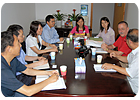
Rick Damato meets with the China
Building Waterproofing staff. (Photo courtesy of CBW.)
Waterproofing Technology in Beijing Olympics 2008
The Olympics called for 37 venues to meet the need of total 28 sport events. 31 venues are located in Beijing and 6 in other cities including Shanghai and Hong Kong. Among 31 venues in Beijing, 19 were new construction and 12 were renovated structures. In addition, there are some attached facilities such as the Olympic Forest Garden and the Olympic Water Park, among others.The owners of the venues and facilities attached great importance to waterproofing and anti-seepage and the most advanced materials and technologies available at home and abroad were used. An advisory group having top experts in the industry in China called for many discussions and examinations concerning waterproofing and anti-seepage design, construction and inspection. The newly built venues include the National Stadium (Bird Nest), National Indoor Stadium, National Aquatics Center (The Water Cube) and National Conference Center in the center zone. The south zone includes Olympic Sports Center Stadium, Ying Tung Natatorium and the south zone has Olympic Forest Garden, Tennis Center, Hockey Field and Archery Field. Some venues are scattered including Beijing University Gymnasium, China Agricultural University Gymnasium. The Beijing Olympic venues are large in span and space and complicated in structure. The areas needing waterproofing total 8 million square meters, including roofs, a man-made lake, man-made wetland and water park. Lightweight environmentally friendly materials, which have multiple functions of waterproofing, insulating, providing quality acoustics, and aesthetically pleasing, were selected for roofs of all venues.
The
National Indoor Stadium in Beijing.
A Million Thanks and a Challenge
There is no way to thank everyone who made this timely trip to China both possible and pleasurable. I do owe a debt of gratitude, especially to Mr. Dongqing Zhu, Mrs. Xu Jianyue, Mr. Xian Yongbiao, Ms. Julia Lu, and my good friend, Mr. G.Q. Zhao. If you have ever been curious about other parts of the world, you are urged to climb off the roof and head to the airport. You will be amazed to see how the rest of the world lives and how they conduct trade. You will be pleased to see how, in some ways, we are truly blessed to live in the U.S.You may, however, be amazed by the things you have missed out on by not traveling around the world. As globalization moves on and the world continues to shrink, I firmly believe that firsthand knowledge of other peoples and other cultures will serve you and your business well in the years to come. Even if that is not the case, you can still enjoy a most pleasant travel experience. I certainly have; and if the Lord is willing I will again.
Mr. G.Q. Zhao and the editors of China Building Waterproofing contributed to this report
Sidebar
The following are specifications for buildings in China courtesy of China Building Waterproofing (CBW) magazine in Suzhou located just a few hours outside of Shanghai. The information was presented in a series of reports in the supplement issue of CBW.Waterproofing roof systems used are as follows:
1. Sheet metal plus membrane
2. Standing seam metal
3. Mechanically fastened reinforced PVC
4. ETFE membrane
5. Spray or brush polyurea elastomer
6. Na-based bentonite carpet
7. HDPE geotextile
8. Self-waterproof concrete plus membrane
9. Planted roof with puncture resistant membrane
System 1 sheet plus membrane used for the National Indoor Stadium:
3 mm polymer modified bitumen self- adhered membrane plus 1 mm Al, Mg, Mn alloy sheet are used for waterproofing and drainage system. The Gymnasium is 212.5 m long (S-N) and 122.5 m wide (E-W), the highest elevation 43 m, total floor area 81000 m2, seats 18000, roof area 24000 m2.
Roof structure (downwards)
0.9 mm AlMgMn standing seam alloy sheet
30 mm 48 Kg /m3 acoustic wool
3 mm self- adhered SBS membrane
8 mm pressed cement board
00 mm 120Kg /m3 mineral wool
8 mm pressed cement board
80 Kg /m3 acoustic wool
0.75 mm roll-formed sheet (915 mm wide)
25 mm fibre spray acoustic material
Application details: (above pressed cement board only)
Pressed cement board is used as substrate for self-adhered membrane, clean and dry
The substrate surface is treated with Special primer
Place self-adhered membrane and pat special attention to overlap and T-type support
Install site-formed alloy sheet, supported by T-type support. Adjacent sheets are interlocked and treated with special machine.
Beijing University Gymnasium
1.5 mm EPDM plus 0.9 mm AlMgMn alloy sheet are used for waterproofing and drainage system. Total floor area is 26900 m2, the highest elevation 31.3 m, seats 8000, and roof area 10000 m2. The roof shapes like rotating PingPang ball.
Roof structure (downwards)
0.9 mm AlMgMn alloy sheet
Mineral wool
1.5 mm EPDM
50 mm extruded insulation
0.3 mm PE film
1 mm galvanized steel sheet
50 mm acoustic wool
Non-woven fabric
0.5 mm colored corrugated AlZn planted sheet
Application details: (above 1 mm galvanized steel sheet only)
Place 0.3 mm PE film on clean dry galvanized sheet with overlap width 100 mm up
Two layers of 50 mm extruded polystyrene and joints in the two layers should be staggered
Loose laid for membrane in plane and fully adhered for others.
Special adhesive is used for overlap and sealant used as well. Pay more attention to T-type supports. See Photos.
Alloy sheet installation same as mentioned above
National Stadium and National Aquatics Stadium use FTFE (copolymer of ethylene-tetrafluoroethylene) membrane system.
National Stadium
Steel roof with area of 60000 m2, one layer of FTFE membrane tensioned in on the top as waterproof layer and one layer of FTFE membrane on the bottom as decorative and acoustic ceiling.
National Aquatics Stadium
Its roof and walls consist of more than 30000 air pillows made of FTFE membrane with various size and shapes, totaling area of 100000 m2 (roof and walls)
Stands of both Olympic Sports Center Stadium and Baseball Field adopt polyurea elastomer as waterproof, wear-resistant and deco layer.
Its structure:
1.2 mm spray polyurea
20 mm polymer fibre reinforced cement mortar protection
1.5 mm polymey cement coating
Concrete stand
Man-Made Marsh and Lake
Na-based bentonite carpet for anti-seepage
The carpet is used in man-made marsh, man-made lake and dragon-shaped water system, totaling area of one million m2. Structure:
Water body
Earth for planting, ≥400
Protection, ≥300
Bentonite carpet
Compacted earth, compacting factor 0.9
Olympic Water Park is 3000 m long (S-N direction) and 900 m wide (E-W direction) with depth of 2-5 m. Total area is 700000 m2. To prevent water loss due to seepage, HDPE (high-density polyethylene) membrane is used to form monolithic layer by welding.
Structure:
Prefabricated concrete plate
Hard mortar layer
Compacted earth
Non-woven fabric
HDPE anti-seepage layer
Non-woven fabric
Compacted earth
Olympic Green covers many venues and has underground traffic channels connecting all parking lots of the venues and commercial center. This is the broad plaza area adjacent to the National Indoor and Outdoor Stadiums as well as the National Aquatic Stadium. When you see the venues on the televised reporting of the Olympics, you will know there is a virtual city beneath the plaza and parts of the other structures. The channel is 15 to 25 m deep, 16 to 25 m wide with clear height of 5 m and total length of 9.87 Km. Due to its importance, “A” level is specified for its waterproofing, i.e. no seepage and no water stain allowed. The channel is made of waterproof concrete with compressive strength of C30-40 and impermeability of P8. Its positive side is fully covered by double layer of 4 m polyester reinforced SBS membrane. The details such as movement joint, construction joint and inside corners and outside corners are waterproofed with various waterproofing materials and combined ways. The total area waterproofed is 500000 m2. Winter and raining season prove its good quality.
Planted roof with puncture resistant membrane
Roofs of underground commercial center, channel and parking lots, totaling 250000 m2, are waterproofed as required for planted roof.
Structure:
Vegetation
Growth media
Filter
Drainage
Protection
Root and puncture resistant membrane
4 mm polyester reinforced SBS membrane
Leveling
Deck
Details:
1.Modified bitumen is brushed on clean, dry leveling layer
2. SBS membrane is torch-applied after above brushed bitumen is dried.
3. Also the root and puncture resistant membrane is torch-applied. Seams of the two membrane layers should staggered 1/3 to 1/2 width of the membrane.
The following is the author’s view of the overall Olympic projects (translated from the original version in Chinese): “Since the most advanced waterproofing materials and techniques are used in Olympic venues and great efforts made by all parties concerned, the waterproofing quality of the venues is good in general. However, some issues should be probed such as sheet steel on metal roof is too thin (0.6 mm) so that deformation may easily occur. It is not easy to clean up surfaces of ETFE membrane and its air pillow roof and wall.”
Looking for a reprint of this article?
From high-res PDFs to custom plaques, order your copy today!