Technical Details: IBC Codes Pertaining to Asphalt Shingles
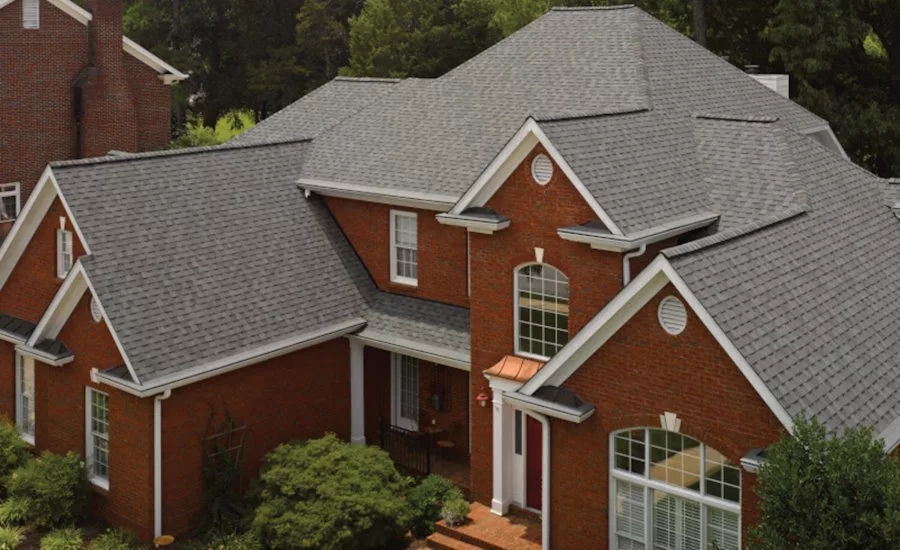
Photo courtesy of CertainTeed.
Section 1507.2 of the International Building Code (IBC) covers the requirements for the application of asphalt shingle roof coverings. The section states that asphalt roof coverings shall be applied in accordance with the standards set in this section and the manufacturer’s installation requirements. The following text provides a brief interpretation of these codes.
The Deck
1507.2.1 Deck requirements. Asphalt shingles shall be fastened to solidly sheathed decks.
Code interpretation: This section implies that shingles shall be applied over a solid, continuous deck material. Typical deck construction consists of Wolmanized structural plywood or CDX. The thickness of the deck shall be 7/16 of an inch to 5/8 of an inch thick and fastened using 8d common nails, 10d box or power-driven nails. The IBC code further states in Section 1609.5.1 Roof deck, that the deck must be designed and installed in accordance with ASCE 7.
The fastening rate of deck to trusses of 16 inches on center (o.c.) or less is one fastener every 6 inches o.c. The fastening rate of deck to trusses of 24 inches o.c. or less is one fastener every 4 inches o.c.

Photo courtesy of the Asphalt Roofing Manufacturers Association.
Slope
1507.2.2 Slope. Asphalt shingles shall only be used on roof slopes of two units vertical in 12 units horizontal (17 percent slope) or greater. For roof slopes from two units vertical in 12 units horizontal (17 percent slope) up to four units vertical in 12 units horizontal (33 percent slope), double underlayment application is required in accordance with Section 1507.2.8.
Code interpretation: This section implies that asphalt shingles shall only be applied on roof slopes of 2:12 or more. Roof application on slopes of 2:12 to 4:12 shall have two layers of underlayment applied in accordance with Section 1507.2.8, which states: “Apply a minimum 19-inch-wide (483 mm) strip of underlayment felt parallel with and starting at the eaves fastened sufficiently to hold in place. Distortions in the underlayment shall not interfere with the ability of the shingles to seal.”
Underlayment securement to the deck shall be completed in accordance with ASCE 7.
Underlayments
1507.2.3 Underlayment. Unless otherwise noted, required underlayment shall conform to ASTM D 226, Type I, ASTM D 4869, Type I, or ASTM D 6757.
1507.2.4 Self-adhering polymer modified bitumen sheet. Self-adhering polymer modified bitumen sheet shall comply with ASTM D 1970.
Code interpretation: These sections imply that underlayment used for asphalt shingle applications shall be manufactured of fiberglass felt, organic felt, modified bitumen or self-adhering modified bitumen. The underlayment shall be applied in one layer for slopes of 4:12 or more and in accordance with Section 1507.2.8 Underlayment application, which states: “Underlayment shall be applied in shingle fashion, parallel and starting from the eave and lapped 2 inches (51 mm), fastened sufficiently to hold in place. Distortions in the underlayment shall not interfere with the ability of the shingles to seal.”
Underlayment securement to the deck shall be completed in accordance with ASCE 7. Application of underlayment in high-velocity wind regions shall comply with Section 1507.2.8.1 High wind attachment, which states that corrosion-resistant fasteners must be used and fastened at the overlap at a maximum of 36 inches (914 mm) on center.
The underlayment is required to protect the structure and its interior contents from moisture damage in the case of shingle displacement or damage. The most common types of underlayment are 15-pound or 30-pound fiberglass felt. The nails are capped head or metal disk with roofing nails.

Detail courtesy of Alvaro Mejia, IRT-Paragon Inc.
Asphalt Shingles
1507.2.5 Asphalt shingles. Asphalt shingles shall have self-seal strips or be interlocking and comply with ASTM D 225 or ASTM D 3462. Asphalt shingle packaging shall bear labeling indicating compliance with ASTM D 3161 or a listing by an approved testing agency in accordance with the requirements of Section 1609.5.2.
Code interpretation: This section implies that asphalt shingles must be manufactured with self-sealing asphalt strips for additional securement. The shingles must be tested by an approved ISO-certified testing agency and comply with the physical property and wind-uplift requirements. Resistant of the asphalt shingle sealant shall be tested in accordance with ASTM D 6381. The wind-uplift resistance of the asphalt shingles shall be tested in accordance with UL 2390. Section 1504.1 Wind resistance of roofs states that for roofs located in high-velocity wind zones (110 mph or greater) the asphalt shingles must be tested in accordance with ASTM D 3161, Class F.
ANSI/UL 2390 Test Method for the Wind Resistance of Asphalt Shingles with Self Seal Tabs was developed through the assistance of the Asphalt Roofing Manufacturers Association (ARMA). ARMA spent nearly 15 years conducting research and testing to help develop the code. The advantage of the code is that it now provides a standard for design and application of shingles in high-velocity wind regions.
Fasteners
1507.2.6 Fasteners. Fasteners for asphalt shingles shall be galvanized, stainless steel, aluminum or copper roofing nails, minimum 12 gage [0.105 inch (2.67 mm)] shank with a minimum 0.375 inch-diameter (9.5 mm) head, of a length to penetrate through the roofing materials and a minimum of 0.75 inch (19.1 mm) thick, the nails shall penetrate through the sheathing. Fasteners shall comply with ASTM F 1667.
Code interpretation: This section gives the parameters for the specific types of fasteners that are requirements for the attachment of asphalt shingles to the deck. The code provides the types of fasteners, the size of the fasteners and minimum penetration requirements.
Attachment
1507.2.7 Attachment. Asphalt shingles shall have the minimum number of fasteners required by the manufacturer and Section 1504.1. Asphalt shingles shall be secured to the roof with not less than four fasteners per strip shingle or two fasteners per individual shingle. Where the roof exceeds 20 units vertical in 12 units horizontal (166 percent slope), asphalt shingles shall be installed in accordance with the manufacturer’s printed installation instructions for steep-slope roof applications.
Code interpretation: This section implies that asphalt shingles shall be secured with a minimum of four fasteners per shingle in temperate wind zones with slopes less than 166 percent. In high-velocity wind zones, six fasteners per shingle are required. For slopes in excess of 166 percent, the shingle manufacturer must be consulted for the number of fasteners required per shingle.
The fasteners should be 11/4-inch No. 12 wire gage shank nails with 3/8-inch diameter heads. The placement of fasteners on three-tab shingles should be below the self-sealing asphalt line. On dimensional shingles, fastening should be within the nailing zone. Further attachment is required in high-velocity wind zones with three 1-inch diameter dabs of asphalt cement at each shingle and two dabs at rakes, hips and ridges.
Looking for a reprint of this article?
From high-res PDFs to custom plaques, order your copy today!